
Running a Sex Offender Check in New York
The New York State Sex Offender Registry is maintained by NY DCJS under Correction Law Article 6-C. Courts set risk levels. DCJS manages statewide registration data and the public routes allowed by law. The online Sex Offender Subdirectory is not the full secure registry. It publishes eligible Level 2 and Level 3 entries, subject to legal exclusions. Level 1 and pending-level registrations stay off the web directory.
Local police agencies handle registration, photographs, address checks, and community notices, then send changes into the New York registry. The state record can therefore be paired with the agency that has local jurisdiction. Use the New York county directory when a current address, registration duty, or suspected failure to report needs local confirmation.
Why Level 1 Stays Offline
A blank web result does not prove that no New York registration exists. The site omits Level 1 records and pending risk levels. Some historic Level 2 and Level 3 entries are also affected by litigation tied to older offense dates and risk hearings. DCJS reported that about 60 otherwise qualifying historic entries remained affected in 2025.
The registry information line fills much of that gap. It can confirm all levels when a caller gives the person's first and last name plus an exact address, full date of birth, driver's-license number, or Social Security number. The caller must identify themself. The official phone-search instructions list those requirements.
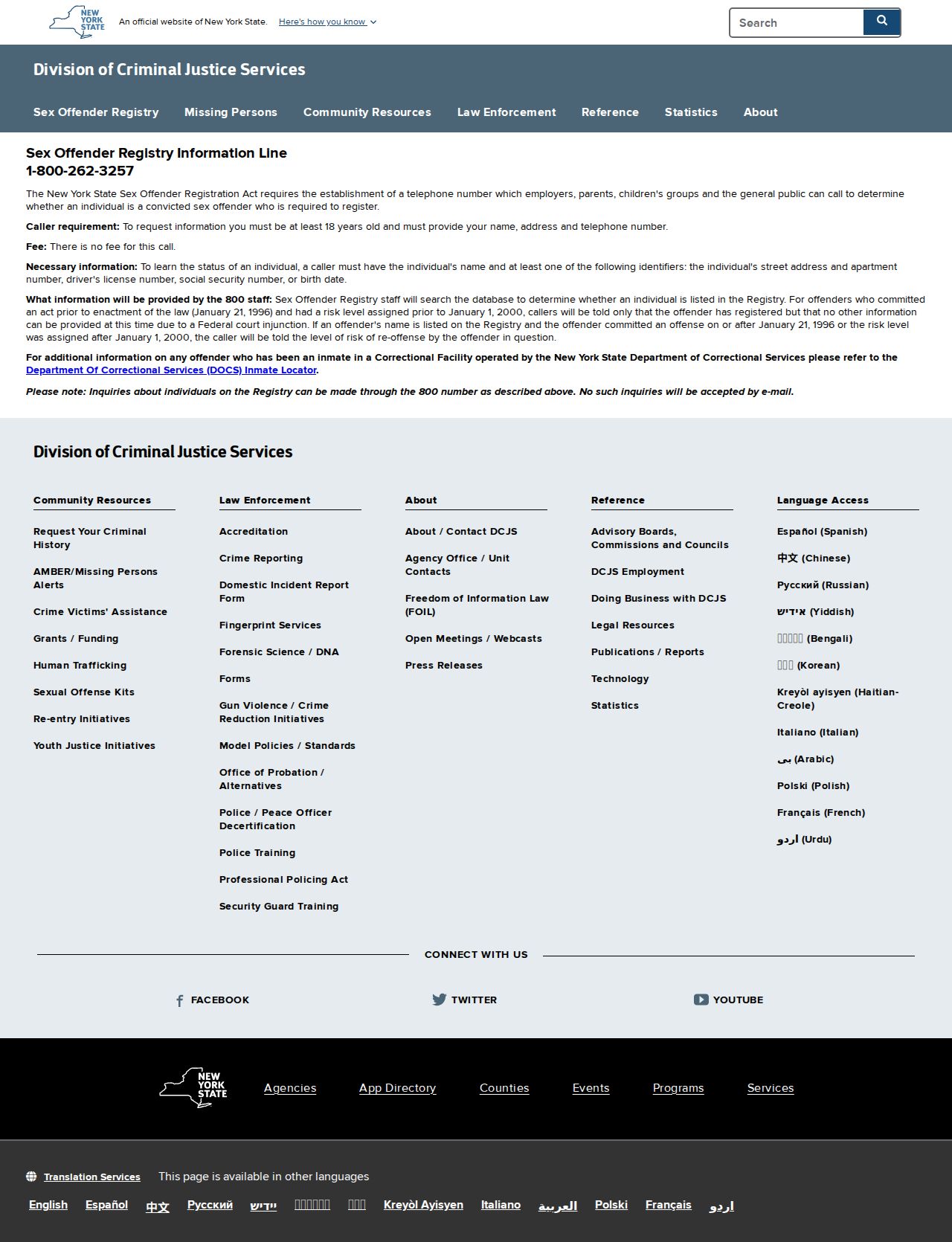
The telephone route reaches beyond the public web list, but it still does not replace the conviction court's file.
How to Search the New York State Sex Offender Registry
The Level 2 and Level 3 Subdirectory accepts one primary route: last name, county, or ZIP Code. It has no street, city, offense, age, radius, or risk-level field. Custody boxes work as exclusions. Match a profile with its photo, aliases, physical traits, status, and conviction facts, not one similar name.
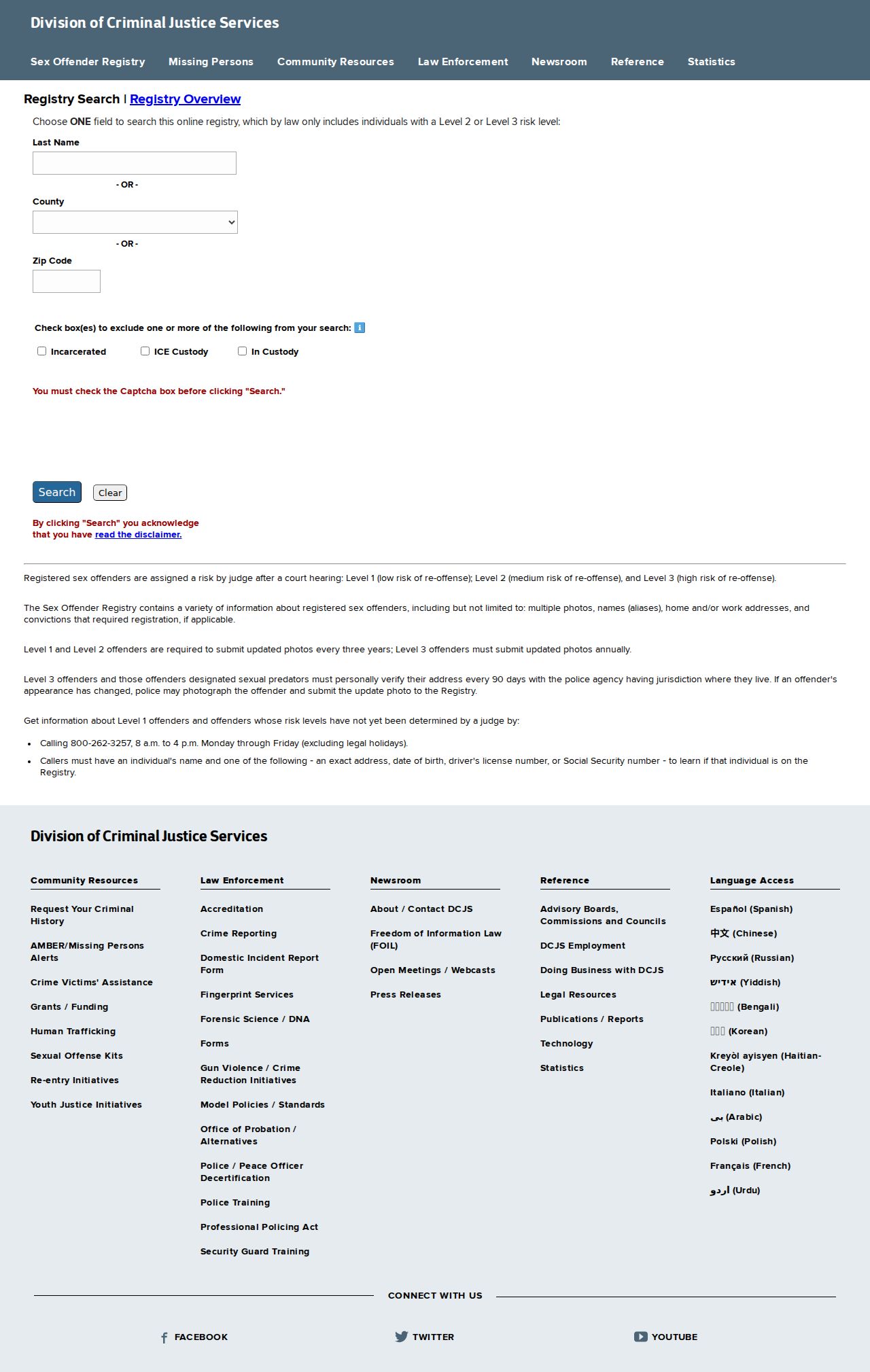
The state landing page separates online access from the broader phone check.
- Open the official DCJS Subdirectory and read its coverage warning.
- Choose last name, county, or ZIP as the one primary criterion.
- Apply any needed custody exclusions, complete CAPTCHA, and submit.
- Open possible profiles and compare several identifiers before reaching a conclusion.
| Field | Type | Required | Notes |
|---|---|---|---|
| Last Name | Text | One route | Maximum 34 characters. |
| County | Dropdown | One route | All New York counties and status options. |
| ZIP Code | Text | One route | Maximum five characters. |
| Custody exclusions | Checkboxes | No | Incarcerated, ICE, and federal-prison categories. |
| CAPTCHA | Security check | Yes | Required before search. |
The live registry form shows these New York search controls.
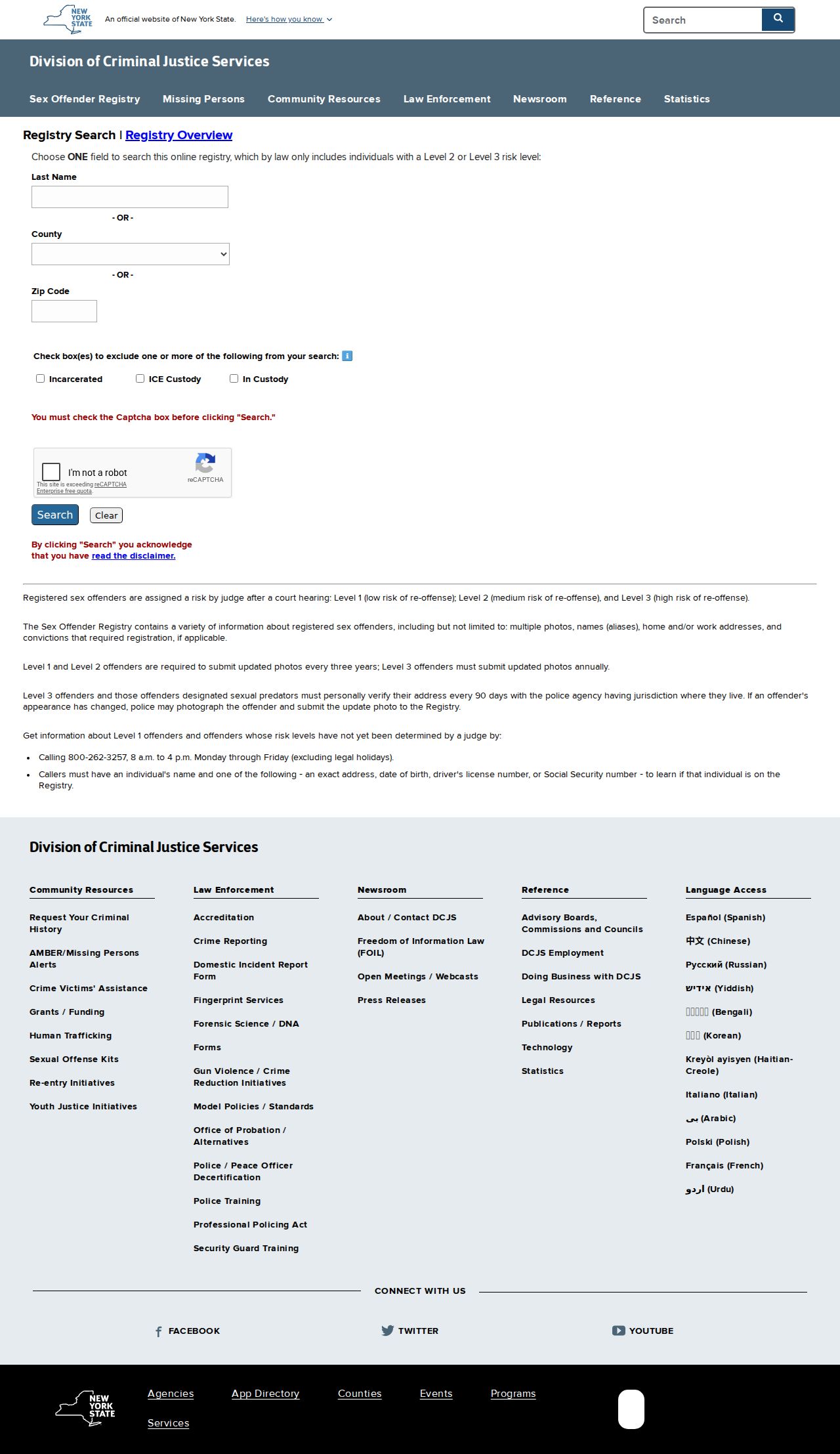
The live form confirms that the registry has no general address-radius search.
NY-ALERT Sex Offender Notices
NY-ALERT differs from a one-time registry search. A free NY.gov account can follow qualifying Level 2 and Level 3 moves into or out of as many as three selected areas. A location can use county or municipality, ZIP, address, or a mix with a radius. Delivery can use email, text, phone, or fax.
The service responds to a reported relocation. It is not a live map of all registrants, a Level 1 alert, or notice of every profile correction. Search current data first, then use alerts for future qualifying changes. Account holders can revise locations and delivery methods. Note: A relocation alert supplements a New York registry search; it does not prove every nearby registration triggered notice.
New York's year-end 2025 report counted 43,064 registered persons, including 13,902 at Level 1, 17,176 at Level 2, 11,054 at Level 3, and 932 with a pending level. That total is not the number shown online. It includes categories the public Subdirectory omits. During 2025, DCJS handled 34,605 toll-free public calls and more than 2.13 million telephone and electronic searches. Those are workload totals, not unique users or a measure of local crime.
Inside a Registry Profile
A public New York profile can join identity, appearance, address, conviction, vehicle, custody, and supervision facts. Field presence varies. Some entries have map, more-photo, and full-detail controls. The listing summarizes registrable convictions and reported current facts. It omits victim identity, secure identifiers, grand-jury proof, police narratives, and the full court docket.
| Name & Aliases | Primary name, aliases, age, risk level, and designation. |
|---|---|
| Appearance | Photos, height, weight, hair and eye color, and distinctive marks. |
| Address & Status | Public residence detail, map control, and custody markers when allowed. |
| Conviction | Qualifying offense, statute, jurisdiction, date, and sentence or release facts. |
| Vehicle & Supervision | Reported vehicle data, supervising agency, and special conditions. |
| Not Included | Victim identity, secure data, and complete source-court papers. |
Facts can change after a move, photo update, level modification, or custody change. Report suspected data errors to SORRequests@dcjs.ny.gov. Get the judgment and risk-level order from the source court.
The status panel deserves close review. A profile may mark state incarceration, federal custody, or ICE custody, and the search form can exclude those categories. A registered address should not be treated as proof of present physical location without checking status. Vehicle and supervision fields also depend on what the source agency reported. DCJS cautions that it cannot guarantee each contributed fact, which is why a disputed item may need correction by the court or police agency that supplied it.
New York Registry and NSOPW
The U.S. Department of Justice National Sex Offender Public Website can help when a name search crosses state lines.
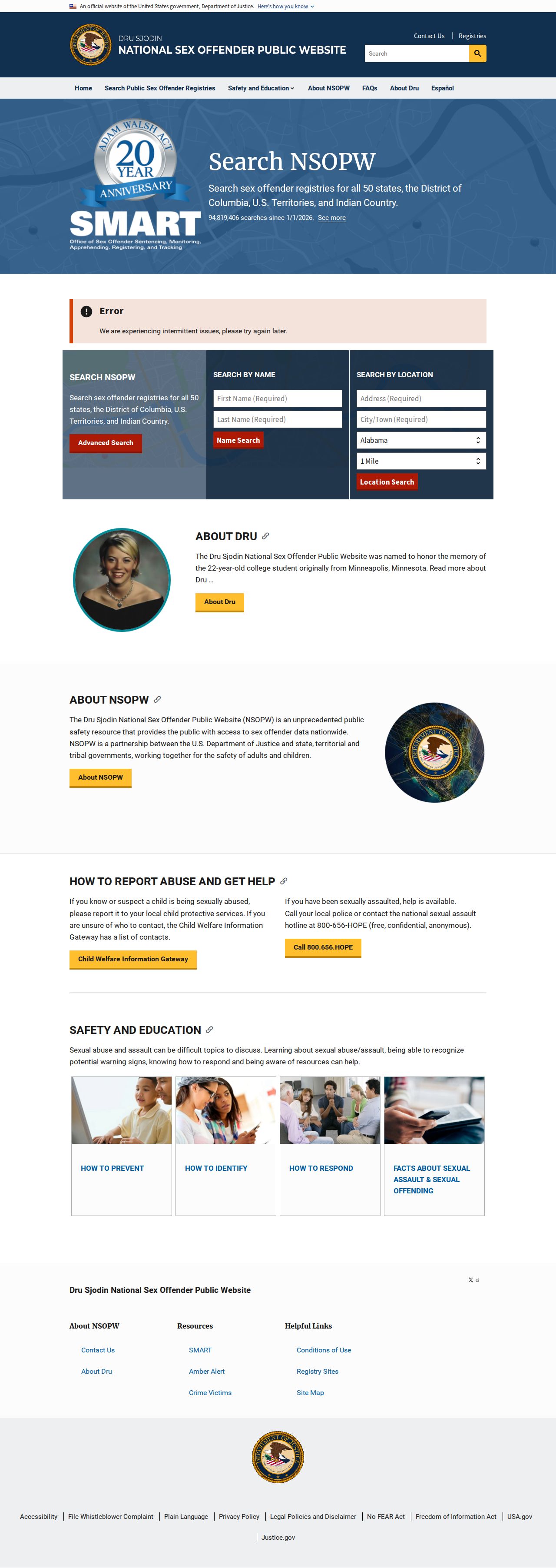
Its national reach does not remove limits set by New York disclosure law.
NSOPW warns that New York does not provide geographic coordinates. A national radius search may miss New York results that appear in the DCJS county or ZIP search. Use NSOPW's name route for cross-state questions, then verify New York data at its source. The FBI's separate National Sex Offender Registry is a law-enforcement system, not public NSOPW.
New York Registration Requirements and Levels
A court assigns Level 1, 2, or 3 after the risk process. DCJS does not choose it. A separate designation, such as sexual predator, sexually violent offender, or predicate sex offender, can control lifetime registration even when level alone suggests another term. Current rules matter because older pages may state former ten-year durations.
| Risk Level | Online? | Duration and Verification |
|---|---|---|
| Level 1, no designation | No | 20 years; annual verification and a local photo every three years. |
| Level 1, designated | Not solely by level | Life; annual verification and photo every three years. |
| Level 2 | Yes, with exclusions | Life; nondesignated petition possible after 30 years; photo every three years. |
| Level 3 | Yes | Life; annual photo and address verification every 90 days. |
The DCJS risk-level table is the current public source.
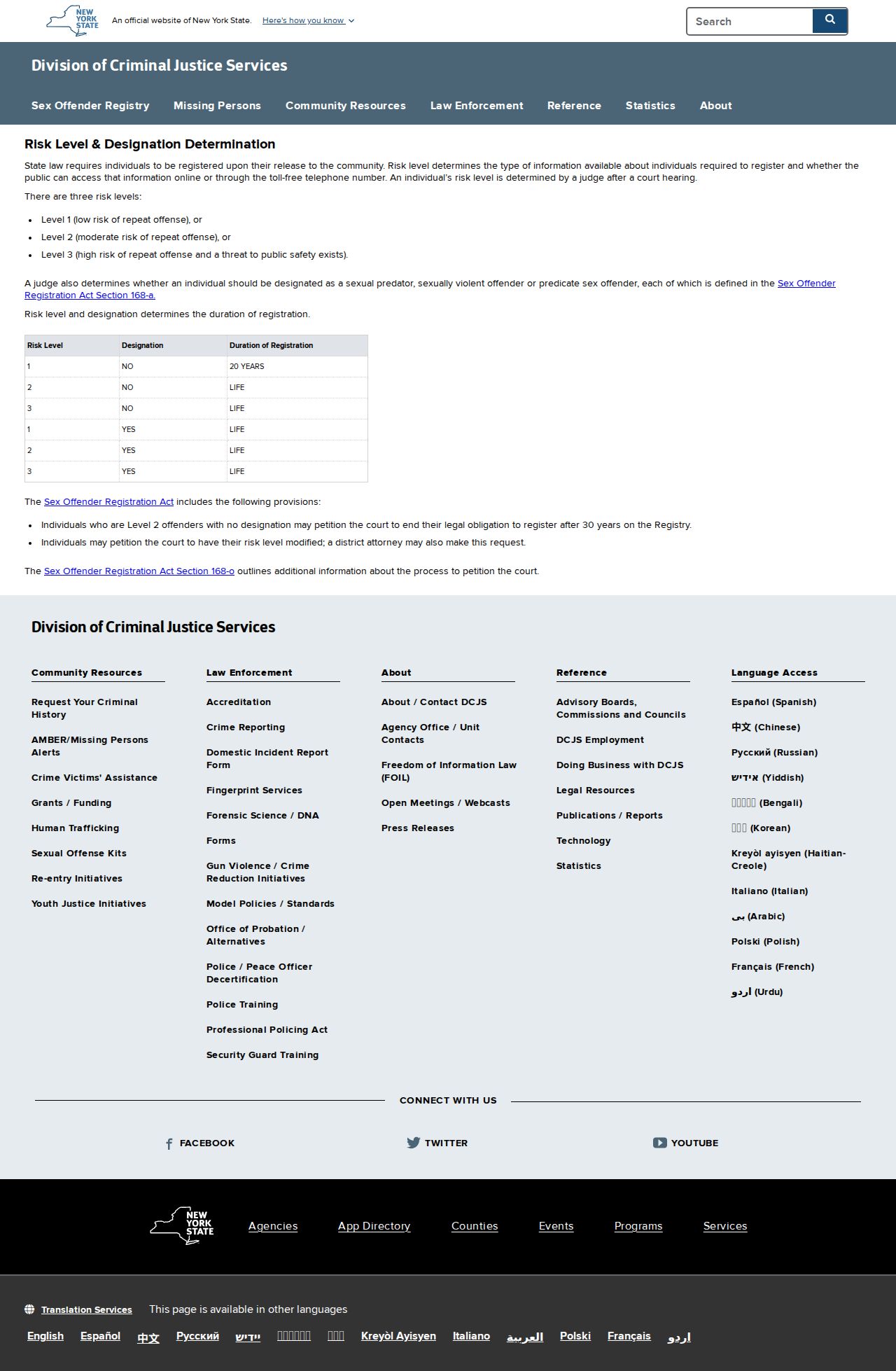
The table shows why risk level and statutory designation must be read together.
New York Registry Since 1996
New York SORA took effect January 21, 1996. Later laws changed duration and public access. Level 2 online publication began in 2006. Relocation alerts followed in 2010, and mobile, map, and profile access was redesigned in 2014. DOCCS completed electronic prison registration intake in July 2025.
A sentencing court certifies registration and makes the risk finding. Before release, the facility and Board of Examiners complete required notices and recommendations. The facility sends registration to DCJS. Police with local jurisdiction then handle in-person duties. That agency is not always a sheriff. Flow: Court or Facility › Risk Hearing › Local Registration › DCJS Registry › Public Access.
Ongoing duties also feed the state file. A registrant must return the annual nonforwardable verification within ten days and report covered address, internet-identifier, and higher-education changes within statutory deadlines. Level 1 and Level 2 photographs are generally updated every three years. Level 3 photographs are updated each year, and Level 3 registrants plus those designated sexual predators verify their address in person every 90 days. Correction Law §168-b sets a $10 fee for each reported address or higher-education status change.
New York Residence Rules
SORA does not create one residence ban for every listed person. Some people on probation, parole, or conditional discharge face Sexual Assault Reform Act terms, including a 1,000-foot school or childcare rule. That term should not be inferred from every profile.
New York's highest court held in People v. Diack in 2015 that the state scheme preempts local residency restrictions. Registry status, address data, and supervision orders answer different questions. The filed court or supervision record is the right source for a current restriction. Note: A mapped registry address does not reveal every court-ordered supervision term.
Lawful Use of Registry Data
New York publishes registry information for safety awareness. It is not permission to contact, threaten, follow, shame, or retaliate against a listed person. Suspected address noncompliance belongs with the police agency that has jurisdiction or DCJS. Emergency services are for an immediate emergency.
Misuse is unlawful. Correction Law §168-q authorizes fines for specified unlawful use, removal, or duplication of registry information. Harassment, intimidation, vigilantism, and criminal conduct are never valid uses.
Section 168-q provides a $500 to $1,000 fine for using directory information in violation of law and up to $1,000 for unauthorized removal or duplication of a local subdirectory. The Attorney General, a district attorney, or an aggrieved person may seek preventive relief.