
Checking Criminal History in New York
Start with the record's source. A person reviewing their own official statewide rap sheet uses NY DCJS Personal Record Review. A public exact-name and exact-date-of-birth court history comes from the Office of Court Administration Criminal History Record Search, or CHRS. WebCrims is free and useful for a known active case or next appearance. None of these products supplies every police narrative, jail intake sheet, or filed court paper.
Identity and purpose matter. DCJS uses fingerprints and returns a mailed record only to the subject or that person's attorney. CHRS uses demographic data and is not fingerprint matched or certified. A local clerk can certify its own disposition, while the arresting agency keeps its report. Keep names, dates of birth, case numbers, arrest dates, and counties separate so a common name does not become a false match.
- Choose DCJS self-review, CHRS, WebCrims, custody lookup, or a local source based on the fact needed.
- Use the exact identifiers required by that official system.
- Open the New York county directory for arrest, jail, police, or original court detail.
- Compare the charge, status, date, court, and disposition instead of relying on a name alone.
- Obtain a Certificate of Disposition or fingerprint review when official source verification matters.
Note: A statewide search can point to a local record, but it cannot replace the county agency or court that created it.
How New York Criminal Records Move
A fingerprintable arrest under CPL 160.10 begins a linked New York record cycle. Police or a sheriff sends prints and arrest descriptors to DCJS. The State Identification Bureau matches or assigns a NYSID. Prosecutors report charging events, and the Office of Court Administration supplies court outcomes. Jail, probation, and DOCCS data can add later custody or supervision events. The practical flow is: Arrest → Fingerprint submission → Court case → Disposition → DCJS rap sheet.
Each handoff can create a delay or gap. A certificate from the source court controls the meaning of that court's outcome. DCJS compiles what agencies report and successfully link. CHRS instead matches an exact name and birth date against eligible court data. A spelling change, sealed event, unmatched transaction, or late disposition can make the products disagree without making either product a complete substitute for the other.
The official NY DCJS gateway shows the agency's statewide role.
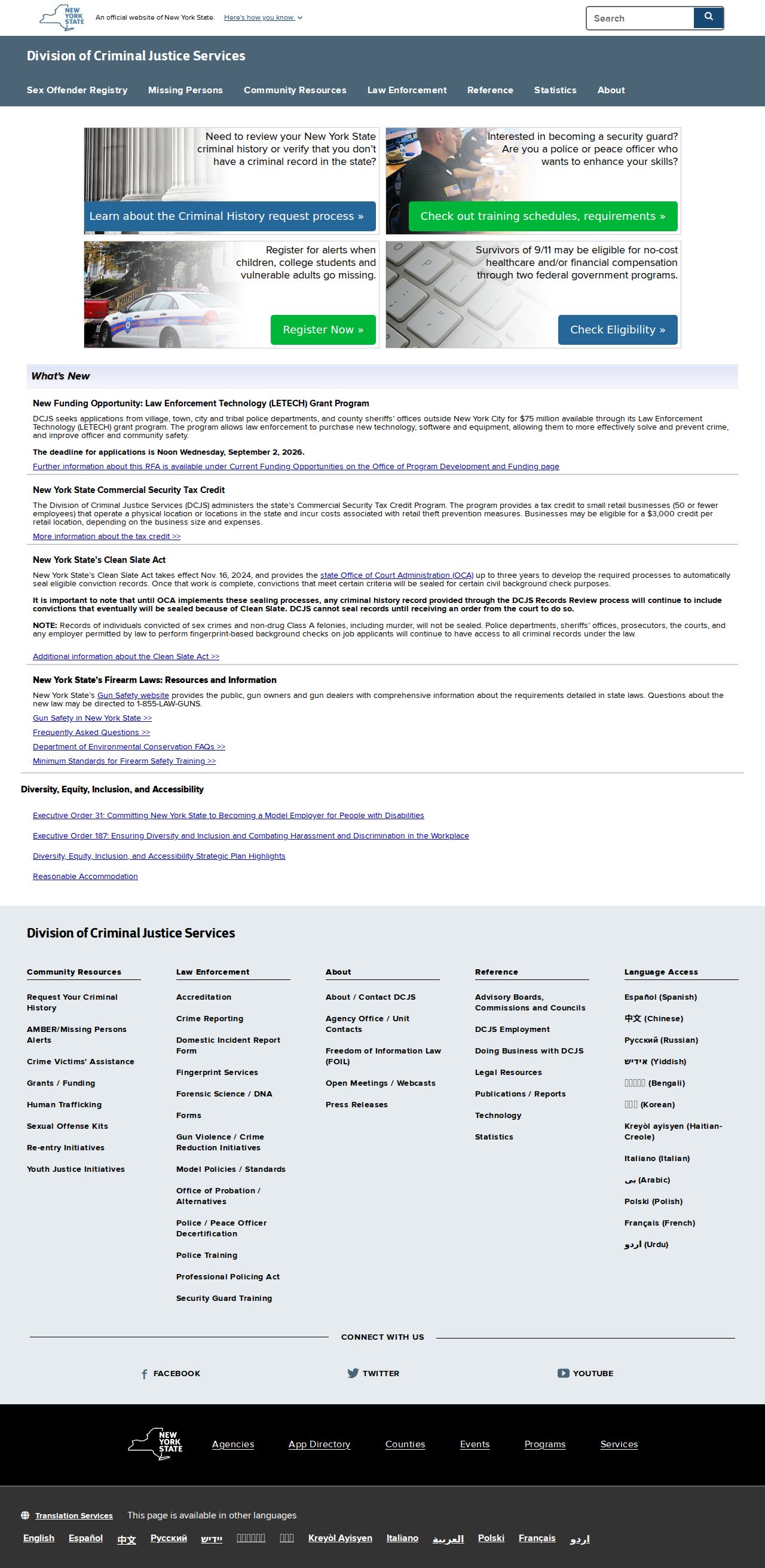
The gateway separates confidential record functions from public statistics, registry access, and agency information.
Inside the New York Criminal History Repository
The New York State Division of Criminal Justice Services maintains the fingerprint-supported Computerized Criminal History system through its Office of Criminal Justice Records. It does not sell a public name search for another person's DCJS rap sheet. Personal Record Review is the official subject-access path. A suppressed response leaves out sealed or otherwise suppressed categories. An unsuppressed response can show maintained cycles that the subject may inspect even when they do not appear in ordinary public court results.
DCJS and OCA answer different questions. DCJS connects a person to arrest and disposition cycles through fingerprints. OCA CHRS searches eligible court records through exact demographic data. WebCrims focuses on public case status and future appearances in participating courts. A county clerk holds the accusatory papers, orders, and certified disposition. The public court product cannot resolve mistaken identity with the certainty of a fingerprint review, and the DCJS rap sheet is not the complete source court file.
Note: New York's official rap sheet is subject-only; public access runs through court records and other records lawfully released by their custodians.
New York Criminal History Self-Review
Personal Record Review begins with an IdentoGO appointment. Service code 15464Z requests a suppressed response, while 15465F requests an unsuppressed response. The two are separate orders. The posted processing fee was $17.50 as of February 2, 2026, and DCJS generally mails the result in three to four weeks. A fee-waiver packet and Cardscan route exist for people who cannot use the standard enrollment path.
The mailed response should be read cycle by cycle. Check the arrest date and agency, charge citations, court and case number, disposition, sentence, sealing notation, and later custody or supervision entries. When a result is wrong, obtain proof from the source. A certified Certificate of Disposition supports a court-outcome correction. The DCJS challenge instructions identify how to dispute the linked cycle. A name-only search cannot settle mistaken identity.
The OCA CHRS product page documents the separate paid court search.
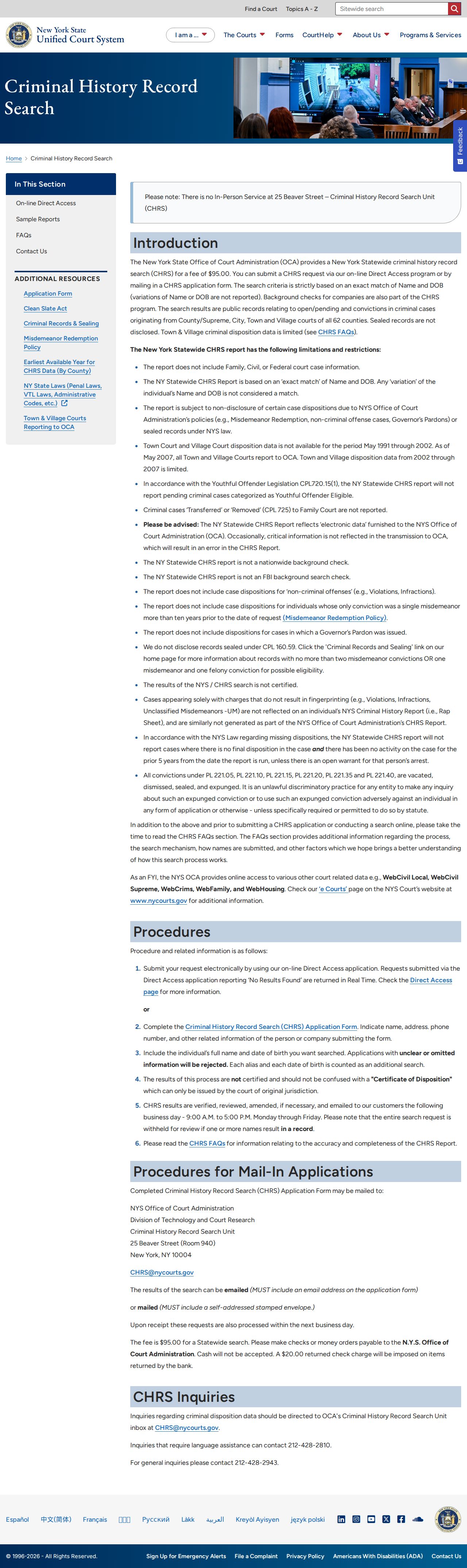
Its exact-match rules, exclusions, and noncertified result explain why the source court still matters.
New York Statewide Record Systems
New York has several statewide tools, but no single master public search. The right system depends on whether the question concerns a personal rap sheet, court history, an active case, state prison, parole, or registry status. Local jails and police reports remain outside these statewide products. Federal custody and federal court cases also use separate federal systems.
| System | What It Holds | Run By |
|---|---|---|
| DCJS Personal Record Review | Subject's fingerprint-supported New York history | NY DCJS |
| OCA CHRS and WebCrims | Eligible court history or public case status | New York State Unified Court System |
| DOCCS Incarcerated Lookup | Qualifying state-prison custody and sentence fields | New York State DOCCS |
| New York State Sex Offender Registry | Public Level 2 and 3 profiles, with legal exclusions | NY DCJS |
The DCJS statistics gateway provides aggregate arrest, disposition, probation, and justice data.
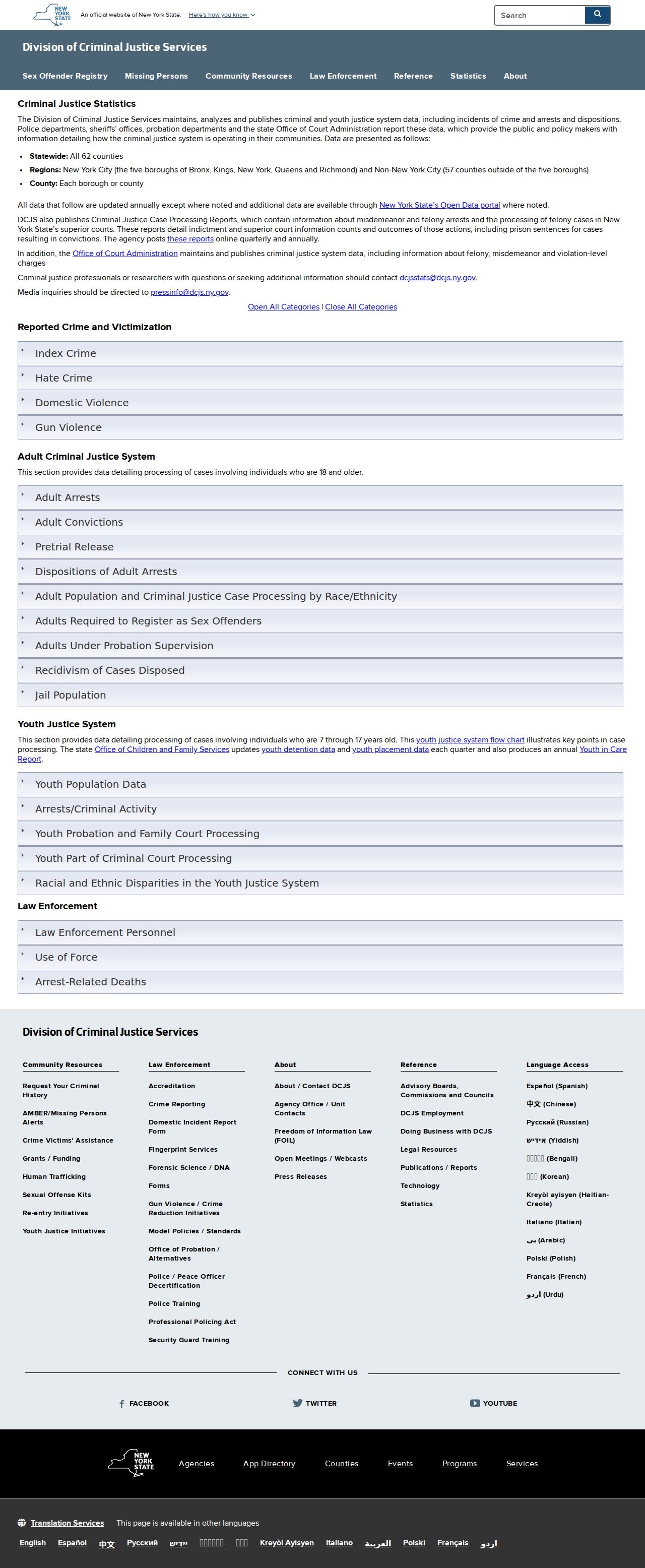
Aggregate totals describe system activity. They cannot identify an individual or replace a criminal record search.
New York Custody and Supervision Records
County jails and New York City custody hold people awaiting trial, serving local sentences, or awaiting transfer. New York has no unified official live roster for every county. The local sheriff or city custody agency may offer a roster, telephone confirmation, records request, or no public live list. New York VINE can supply status and notification for participating agencies, but it is not a booking sheet or rap sheet.
DOCCS operates the separate state-prison and community-supervision system. Its Incarcerated Lookup accepts DIN, NYSID, or name fields and can show custody, facility, offense, sentence, and release data within statutory limits. The Parolee Lookup covers parole and post-release supervision. Probation is different again: local departments supervise it under DCJS oversight, and the public should verify the sentence through the originating court.
The official DOCCS Incarcerated Lookup is the state-custody channel.
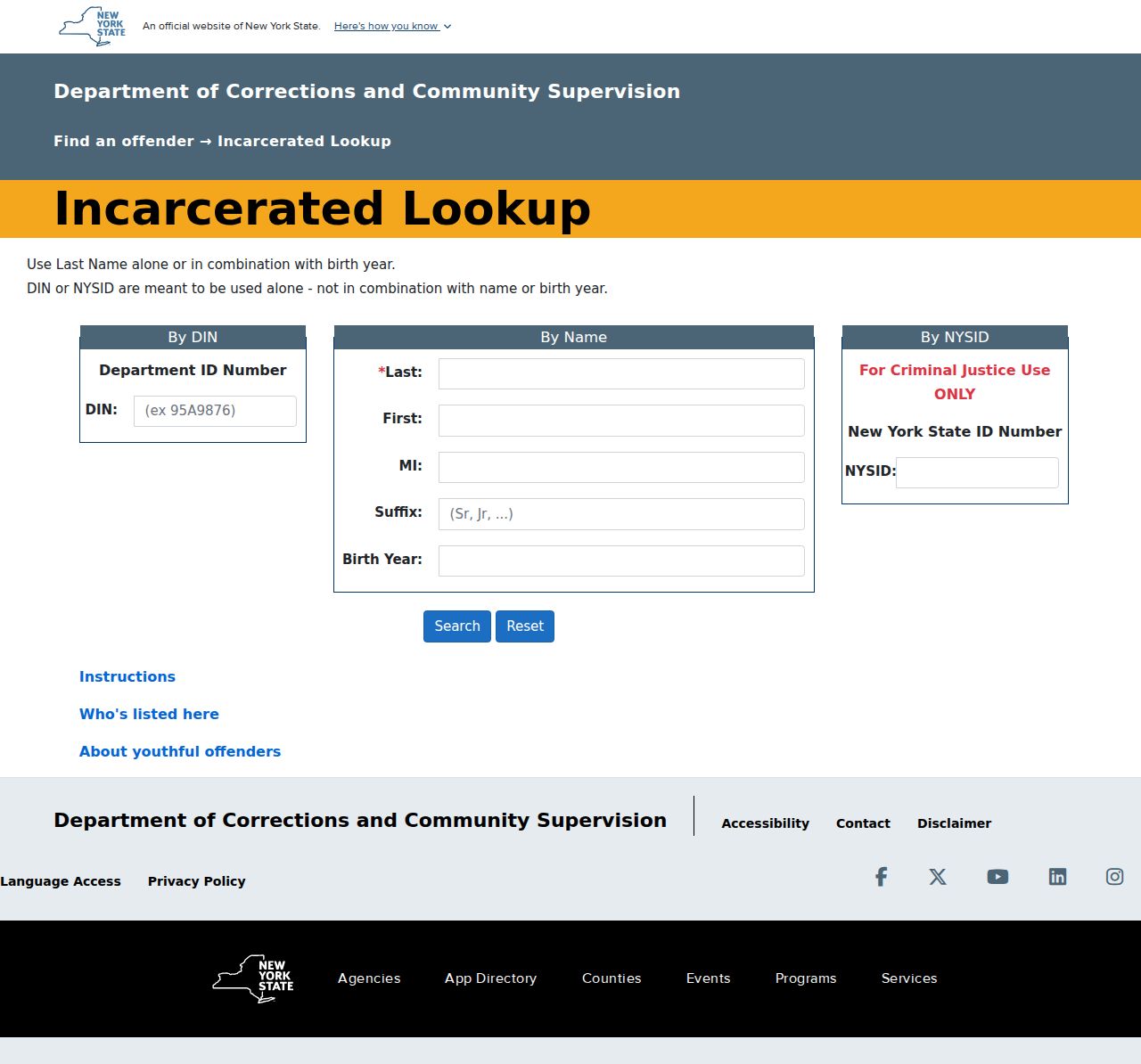
A no-result response does not clear county jail, federal custody, or records removed under DOCCS retention rules.
Types of New York Criminal Records
One event can produce several New York records. The police report describes what the agency recorded. The jail booking covers intake and custody. The court file shows the accusation, appearances, orders, disposition, and sentence. The DCJS rap sheet compiles fingerprint-linked cycles. Each custodian controls its own source record and applies its own access rules.
- Arrest and booking records: created by police and local custody agencies; they record an allegation and detention, not guilt.
- Criminal court files: held by the court that heard the case, with certified dispositions issued by its clerk.
- Warrants: issued through courts and law enforcement, with no complete public statewide New York warrant search.
- Custody and supervision: split among county jails, DOCCS prison and parole, and local probation departments.
- Registry records: maintained statewide by DCJS, while local agencies handle registration and verification.
- Disposition
- The recorded outcome of a charge or case, not merely a status that the case exists.
- NYSID
- The New York State Identification number used in the fingerprint-supported system.
- Rap sheet
- The DCJS record of arrest and prosecution, organized around identity and event cycles.
- Sealing
- A legal access restriction that preserves limited authorized access rather than deleting every record.
New York Warrants and Police Records
No general-public statewide warrant database was located in the research. A bench warrant may arise in a City, District, Town, Village, New York City Criminal, County, or Supreme Court matter. WebCrims can show some warrant-related case information, but it is not a warrant-clearance certificate. The sound route is to check the known case, call the issuing clerk, use any official county sheriff channel, and seek advice about appearance or surrender when resolving one's own suspected warrant.
Police and incident reports remain with the agency that created them. New York State Police does not hold local police or county sheriff reports. A focused request should give an incident number when known, event type, date, time, location, involved names, and the precise existing records sought. FOIL permits redaction or withholding for active investigations, privacy, confidential sources, fair-trial concerns, and safety. Crash, 911, and body-camera records can follow different rules and custodians.
Note: An empty online result is not proof that no warrant or police record exists.
New York Public Access Laws
The New York Freedom of Information Law governs access to existing executive and local agency records, subject to exemptions. It does not make an individual DCJS rap sheet public. Court clerks supply court files under judiciary law and court rules. Sealing and confidentiality statutes can override ordinary disclosure. A requester should identify the correct custodian before assuming that a denial from one office means the record cannot be obtained anywhere.
Key New York laws:
Public Officers Law Article 6 gives access to agency records subject to privacy, law-enforcement, and other exemptions.
Executive Law §837 authorizes DCJS criminal-history systems and controlled dissemination.
Judiciary Law §255 governs lawful clerk searches and certification upon payment of applicable fees.
CPL 160.50 seals qualifying favorable terminations across police, prosecutor, court, and repository records.
CPL 160.57 creates automatic Clean Slate sealing for eligible convictions under its conditions and exclusions.
New York Criminal Records and Sealing
New York uses record sealing rather than a broad adult-conviction expungement process. CPL 160.50 covers qualifying favorable terminations. CPL 160.55 addresses certain noncriminal outcomes. CPL 160.58 and 160.59 cover narrower treatment-related or application-based paths. Youthful-offender adjudications are confidential, and marijuana law separately expunged qualifying older convictions.
Clean Slate under CPL 160.57 adds automatic sealing after statutory waiting periods for eligible convictions, with pending-charge, incarceration, offense, and other limits. Statewide implementation is still underway, with the judiciary required to complete eligible legacy sealing by November 2027. During that work, a DCJS review can show a conviction expected to become sealed later. A sealing application or correction begins with the court of conviction and then must flow correctly to DCJS and other custodians.
The distinction matters: sealed does not mean every historical trace was destroyed. Authorized access can remain, and a stale copy may no longer reflect the current legal status.
New York Criminal Justice by the Numbers
New York's record systems operate at very different scales. DCJS processed 415,778 arrest fingerprint requests in 2024. Its Standard Practices Manual identifies more than 3,000 justice agencies whose reports and transactions must be coordinated. DOCCS reported 41 active facilities and 34,066 incarcerated people on July 1, 2026. Those figures measure fingerprint traffic, organizational scope, facilities, and state custody. They are not interchangeable counts of people with convictions.
The DOCCS population dashboard publishes downloadable state-custody data.
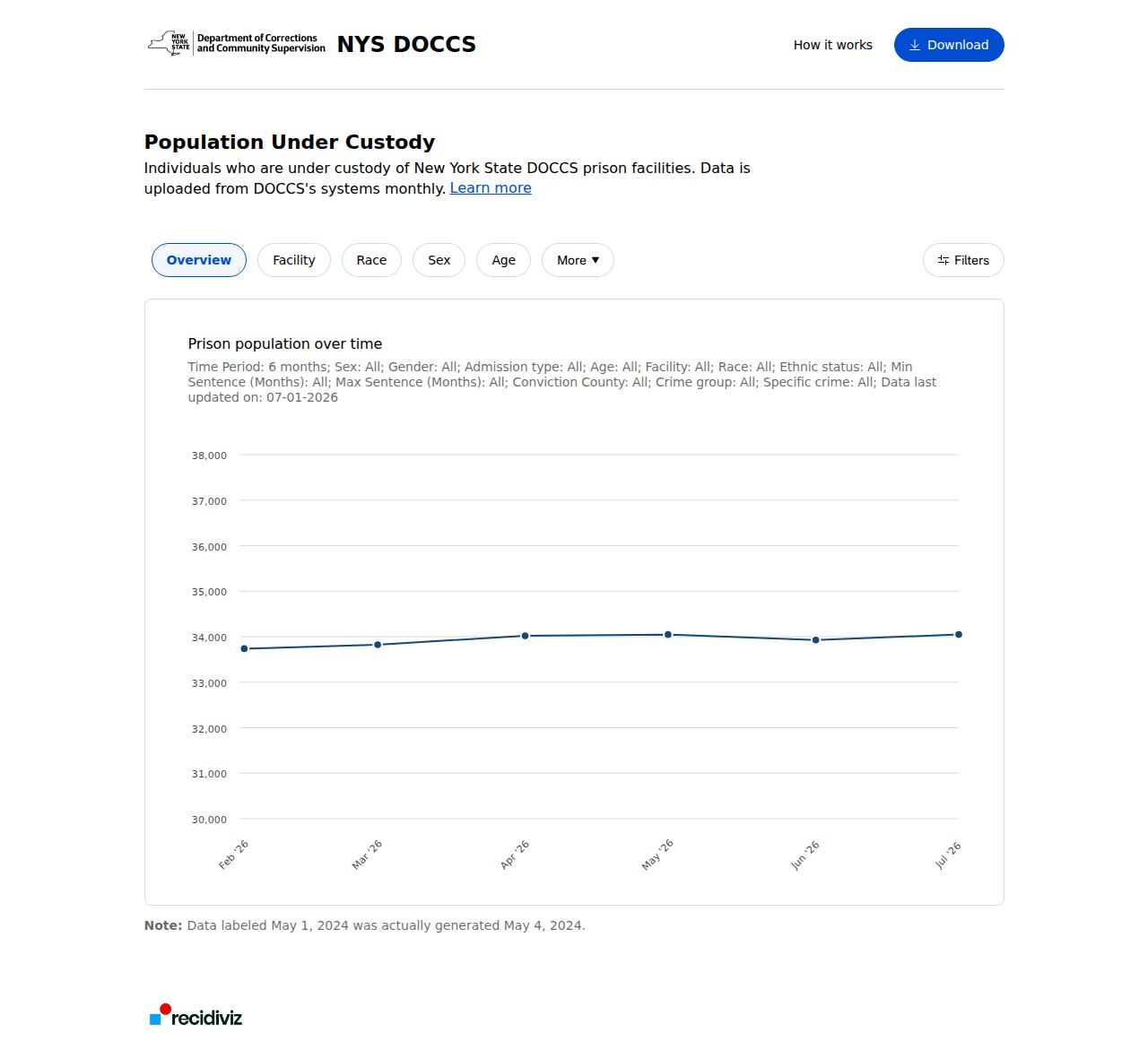
Its filters describe the state-prison population and should never be combined with county jail totals as if both were one custody system.
DCJS adult arrest data likewise counts events by the most serious fingerprintable arrest charge, not unique people or convictions. Arrest, disposition, and prison totals use different units and dates. A personal search must return to the source record rather than infer an individual's history from aggregate statistics.
New York Probation and Parole Records
Probation is local in New York. County departments and the New York City Department of Probation supervise court sentences under the statewide oversight of the DCJS Office of Probation and Correctional Alternatives. OPCA does not publish names or confirm whether a person is on probation. The sentencing court's Certificate of Disposition is the starting point for proving that probation was imposed, while local departments control what supervision material may be released.
Parole and post-release supervision belong to DOCCS. The DOCCS Parolee Lookup supports DIN, NYSID, or name and birth-year routes.
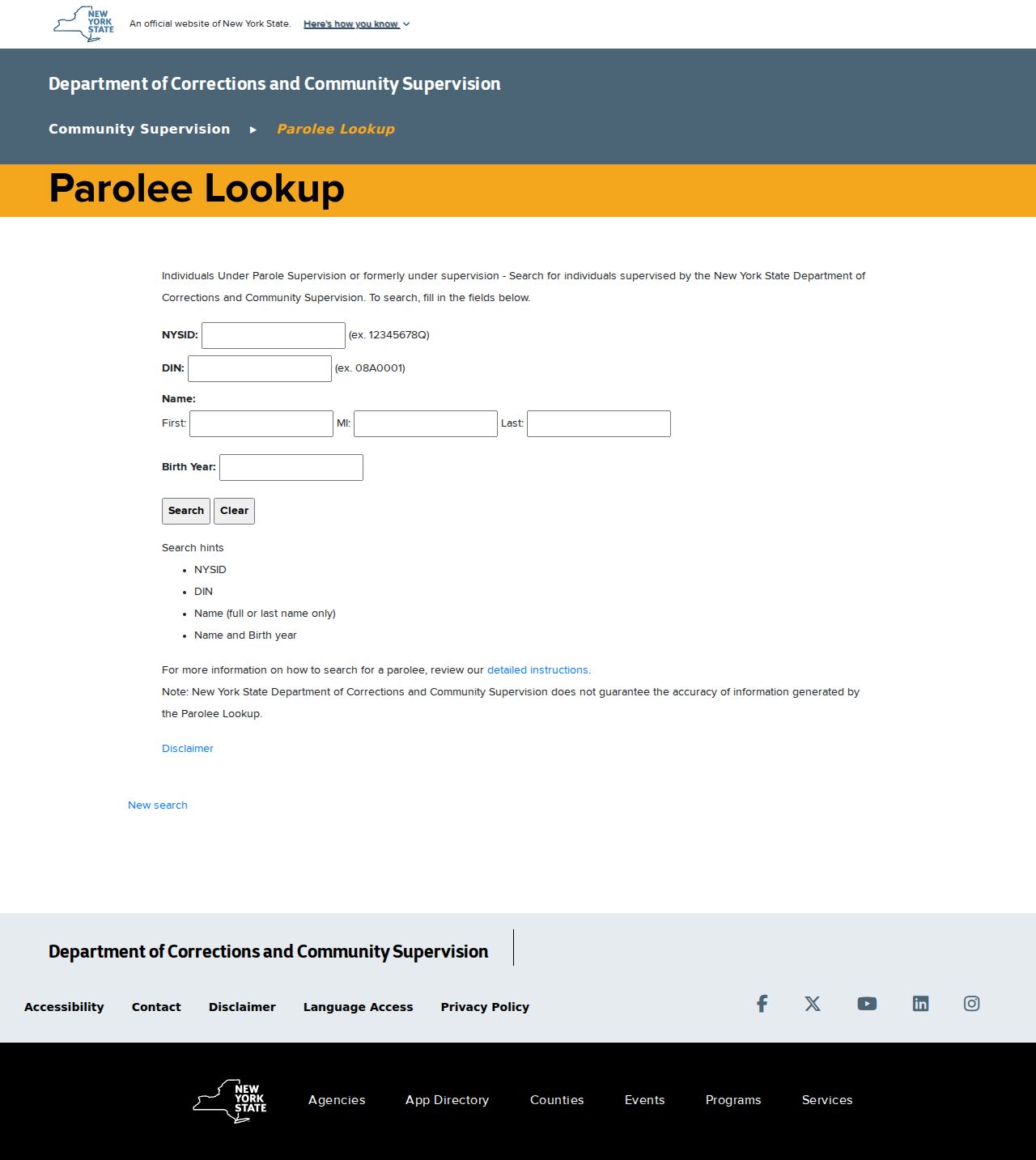
The lookup is a current status tool, not the complete supervision file or the source court judgment.
New York VINE offers a different service. It can send custody status notices for participating agencies, but it does not supply every transfer notice, Parole Board event, booking record, or rap sheet. These distinctions keep a search tied to the agency with the relevant legal record.
New York Criminal Record Fees
Price does not measure completeness. The less costly DCJS product is fingerprint matched and limited to the subject or attorney. The more costly OCA product is a public, exact-name and birth-date court search that is neither fingerprint verified nor certified. County and local copy prices remain separate. Fees below reflect the August 2026 research and should be checked with the live custodian before ordering.
| New York record channel | Base fee | What the payment covers |
|---|---|---|
| DCJS Personal Record Review | $17.50 | Fingerprint processing for a suppressed or unsuppressed mailed response |
| OCA CHRS | $95 | One exact name and date-of-birth combination |
| NYSP incident report | $15 | A qualifying State Police incident or investigation report |
| Ordinary FOIL paper copy | Generally $0.25 per page | Copies up to 9 by 14 inches when no other statute controls |
A court certificate, local police copy, archival retrieval, or mailing charge can follow another schedule. Inspection may avoid some copy costs. No public-use fee was found for WebCrims, the registry Subdirectory, the registry phone line, the basic VINE service, or the DOCCS public lookups.
New York Criminal Records Outside State Systems
Federal cases do not enter a New York county court file merely because the event occurred in the state. New York has four federal judicial districts. PACER supplies federal dockets, while the Bureau of Prisons locator covers federal custody. The FBI Identity History Summary is a subject-only fingerprint product and does not replace a New York court certificate or the DCJS correction process.
State and federal systems can overlap when an arrest submission reaches the FBI, but their source files remain distinct. Begin with the court that filed the case and the custody system that holds the person. A state WebCrims result will not clear a federal docket. A DOCCS result will not clear BOP custody. The same source-first rule prevents a search from treating one database's silence as proof across every jurisdiction.
New York's own correctional and court systems should also stay separate. A DOCCS profile may summarize conviction and sentence fields, yet the county or city court retains the judgment and docket.
New York Safety and Notification Records
The New York State Sex Offender Registry and New York VINE serve different safety questions. The public registry Subdirectory displays eligible Level 2 and Level 3 profiles. Level 1 and pending status require the official telephone route with the required identifiers. NY-ALERT can send qualifying relocation notices. Registry information must be used lawfully and never for harassment, intimidation, vigilantism, or crime.
VINE focuses on custody status and notifications for participating agencies. It is not a criminal history. The official New York VINE interface supplies the notification route.
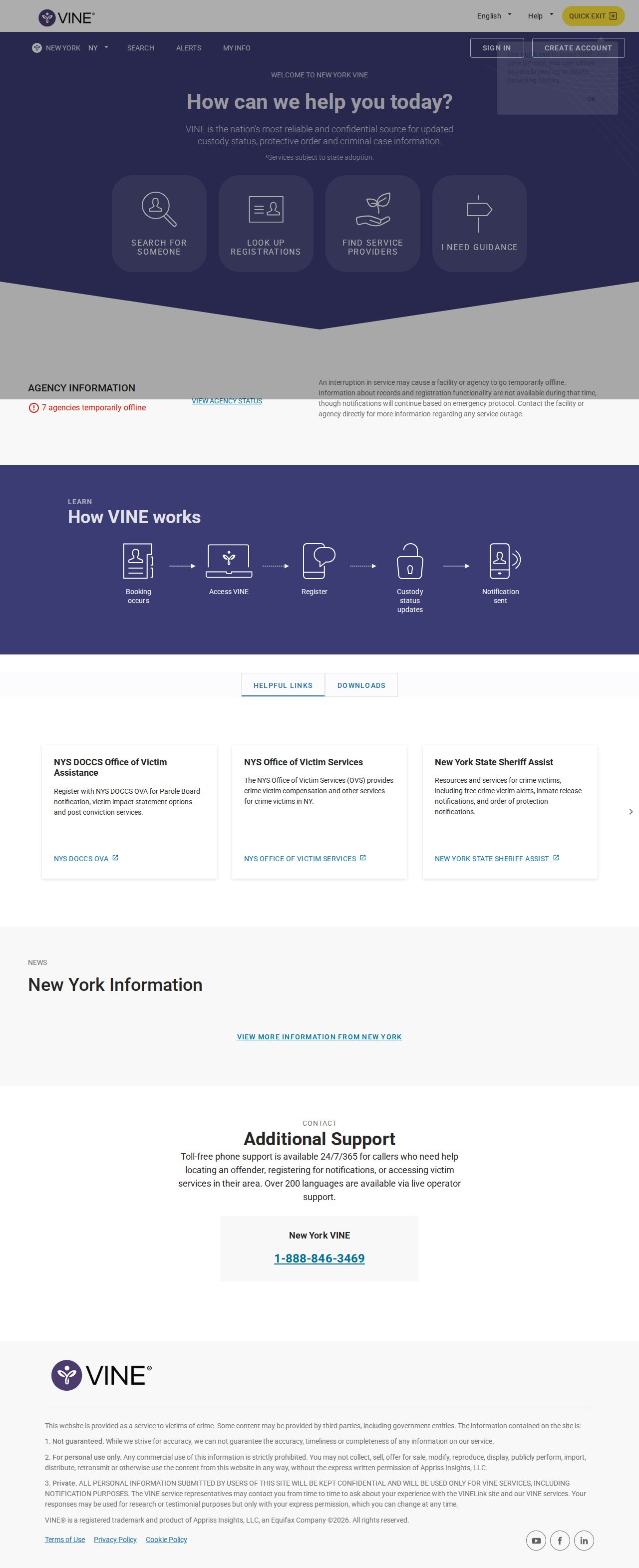
Because participation and event coverage vary, a VINE result should be checked against the county jail, city custody agency, DOCCS, or source court.
Criminal Records by County in New York
New York's 62 counties are the routing layer for arrest reports, jail records, source court files, and local probation information. The five New York City counties use citywide police and jail structures, while many counties outside the city use sheriff, County Court, and local court channels. The largest metro counties below are starting points, not statewide custodians.
Kings County
Brooklyn · New York City's largest county, using city criminal court and custody systems.
Queens County
Jamaica · NYC Criminal Court and Supreme Court split local and felony records.
New York County
Manhattan · Major state and federal court records remain in separate systems.
Suffolk County
Riverhead · District, local, and County Courts create distinct record layers.
Bronx County
Bronx · City police, jail, Criminal Court, and Supreme Court channels apply.
Nassau County
Mineola · District Court handles much local work while County Court hears felonies.
Westchester County
White Plains · Local courts and County Court feed Ninth Judicial District records.
Erie County
Buffalo · Buffalo City Court and Erie County Court appear in statewide search notes.
Browse the full directory of all 62 New York counties to open the criminal records site for any county.