
What the New York State Division of Criminal Justice Services Is
The New York State Division of Criminal Justice Services is an executive agency, not a unit of the State Police. Executive Law §837 assigns DCJS central criminal-history, identification, crime-data, training, and support duties. Its Office of Criminal Justice Records operates the Computerized Criminal History system and the Statewide Automated Biometric Identification System, or SABIS.
DCJS also publishes public aggregate data, oversees local probation through a separate office, supports public safety and forensic programs, and maintains the state sex offender registry. Those functions do not make confidential rap sheets public. The repository supplies criminal history only through channels authorized by law. Its statistical dashboards and Level 2/3 registry are separate public products.
NY DCJS at State Scale
Repository work runs around the clock. In 2024, DCJS processed 415,778 arrest fingerprint requests, 792,051 civil fingerprint requests, and 50,967 other or offender fingerprint requests. The State Identification Bureau reports an average arrest transaction under 15 minutes. SABIS allowed comparisons against more than 11 million people in New York holdings and more than 100 million in the FBI system.
New York's decentralized justice network adds complexity. The statewide reporting manual identifies more than 3,000 state and local justice agencies. Each handoff can affect the final record. DCJS therefore uses identifiers such as NYSID for a person and CJTN for an event. A court docket number identifies a prosecution, while a DOCCS DIN identifies a prison commitment. Mixing those numbers can send a correction to the wrong record.
The 2024 workload also included 180 latent prints examined for 73 investigations. Store and Forward accepts electronic transactions every day of the year and returns identification or rap-sheet responses to contributing criminal justice agencies. These figures show the repository's operational scale, but they do not count distinct people with public records. Civil submissions, arrest prints, offender transactions, and latent-print work are separate streams.
NY DCJS Criminal History Check Options
NY DCJS does not sell a public name search. Personal Record Review is for the subject or that person's attorney and requires fingerprints. The suppressed response omits sealed and suppressed categories. The unsuppressed response shows maintained material available to the subject, including categories hidden from ordinary disclosure. Each response needs its own service code and separate request.
| Product | Who May Order | What It Returns | Cost |
|---|---|---|---|
| Suppressed Personal Record Review | Subject or attorney | Fingerprint-matched record without suppressed categories | $17.50 in New York |
| Unsuppressed Personal Record Review | Subject or attorney | All maintained cycles available to the subject | $17.50 in New York |
| No-record response | Subject or attorney after fingerprints | Confirms no New York history is on file | Included |
| Fee-waiver route | Person unable to pay | Paper packet and fingerprint-card review | Waiver requested |
| Incarcerated-person review | Person in state or local custody | Own DCJS criminal history | No charge, subject to rules |
Out-of-state enrollment cost $57.45 as of February 2, 2026. Cardscan cost $17.50 plus any local fingerprint-taking fee. Fees and appointment terms should be checked again before ordering.
OCA CHRS is a related court product, not a DCJS service. Any requester may pay $95 for each exact name and date-of-birth combination. The result covers eligible public court data, is not fingerprint matched, and is not certified. A no-result response can reflect exact-match limits. Personal Record Review answers what New York's official fingerprint repository holds about the subject. CHRS answers what the eligible public court index returns for supplied demographics.
NY DCJS Suppressed or Unsuppressed
The two IdentoGO service codes change the response. Code 15464Z requests suppressed review. Code 15465F requests unsuppressed review. Asking for both means two appointments. An unsuppressed copy can show favorable-termination cases, eligible violation seals, treatment-related seals, court-sealed convictions, youthful-offender adjudications, and other maintained suppressed material available to the subject.
Clean Slate implementation adds a time-sensitive issue. DCJS warns that Personal Record Review may keep showing convictions eligible for CPL 160.57 until OCA completes the sealing steps. A visible item does not by itself prove the conviction is ineligible. Compare the record with the court's order and current implementation status. Note: Choose the response based on self-review needs, not on an assumption that one code can later be changed.
How Records Reach NY DCJS
For fingerprintable arrests under CPL 160.10, police or sheriffs send prints and arrest descriptors to DCJS. The repository matches or assigns a NYSID and adds an arrest cycle. Prosecutors report charging and indictment events. OCA sends the disposition and sentence. Jails, DOCCS, probation, and parole agencies add custody or supervision facts within their reporting roles.
Data flow: County Arrest › Fingerprint Submission › New York State Division of Criminal Justice Services › Court Disposition Reporting › Rap Sheet
The rap sheet is a compilation of matched reports. A missing final outcome may reflect delay, bad linking, an alias, an old paper record, or source error. The court's Certificate of Disposition remains the authority for that court result. The freshest papers often remain with the county that created the record.
Inside NY DCJS Fingerprint Operations
The State Identification Bureau fingerprint service describes the 24-hour operation behind New York identification.
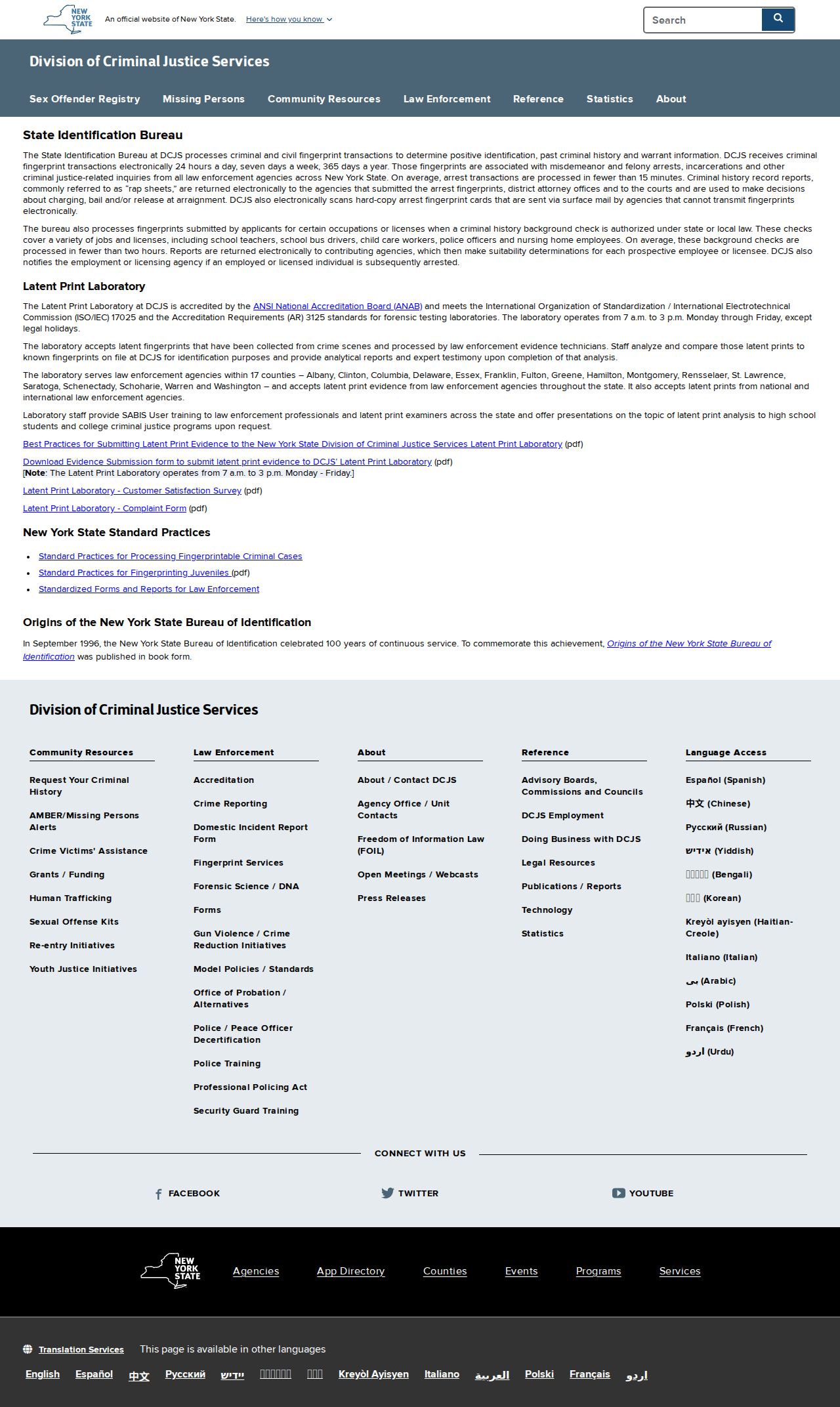
The service connects local submissions with state and FBI biometric systems rather than offering a public search screen.
Store and Forward securely carries prints, palmprints, photos, signatures, event facts, and biographical data. Electronic criminal submissions are now the norm. Hard-copy cards are exceptional. Authorized responses can move through eJusticeNY to qualified agencies under security agreements, but that portal is not open to the public.
Ordering a Check From NY DCJS
The official self-review begins through IdentoGO by IDEMIA. Enrollment uses the correct service code, a current appointment location, identity documents, contact facts, and a mailing address. DCJS mails the response in about three to four weeks. There is no email delivery or counter pickup.
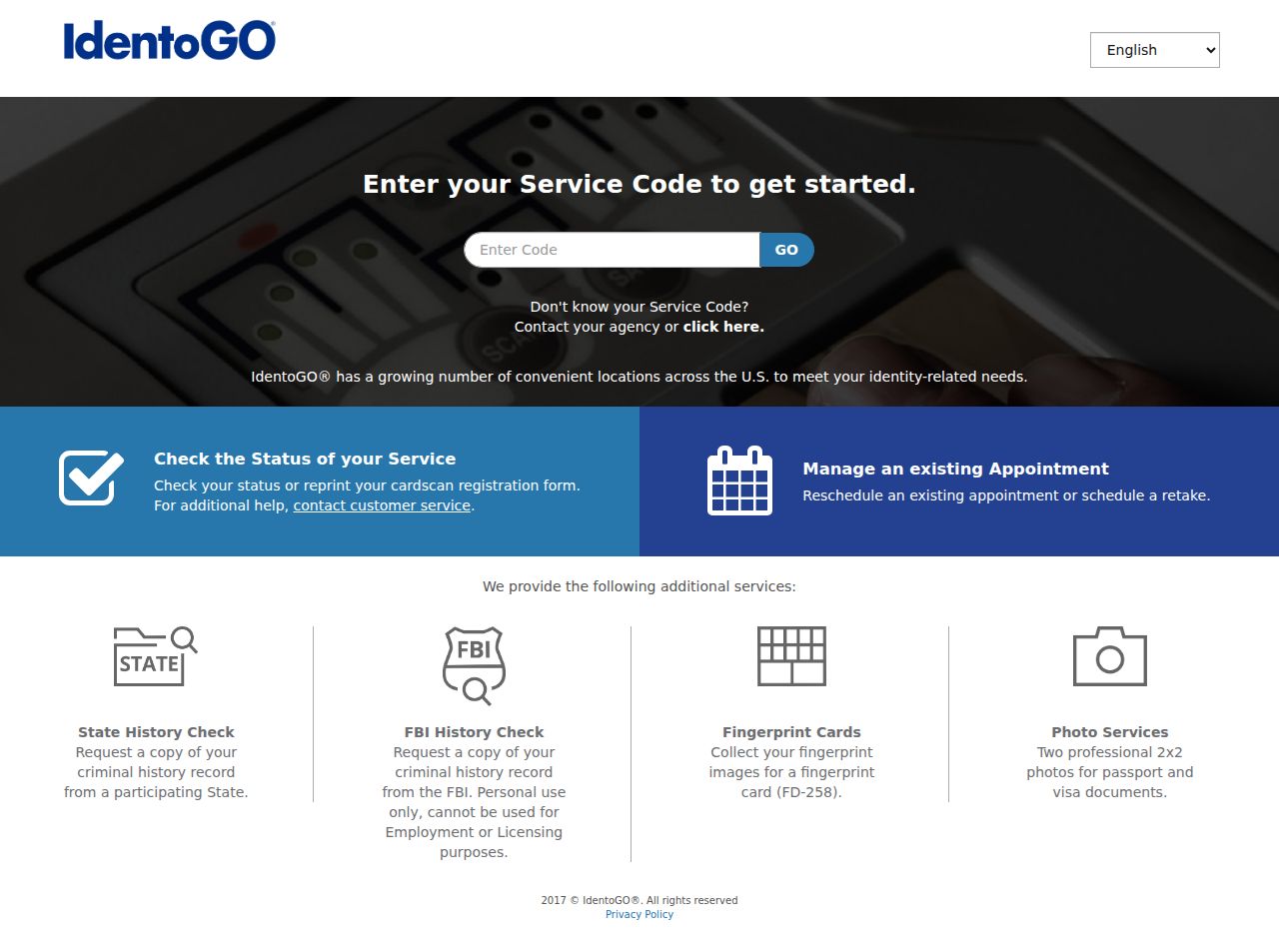
The enrollment service locates current sites and appointments, avoiding reliance on a storefront that may move.
- Choose suppressed review, unsuppressed review, or the paper fee-waiver route.
- Enter service code 15464Z or 15465F and select an available location.
- Bring accepted identification and use the current mailing address.
- Pay the current fee unless DCJS approved a waiver, then keep the receipt.
- Read the mailed response and obtain source-court certificates for disputed results.
From Fingerprints to NY DCJS
New York authorized systematic inmate measurement records in 1896. Experimental fingerprint collection began in 1903, and the State Prison Department Fingerprint Bureau opened in 1913. Fingerprint and Bertillon files were merged in 1918. The Division of Identification entered NYSIIS in 1962, then NYSIIS and other bureaus combined into DCJS in 1972.
Automated latent searching began in 1989. Statewide AFIS installation finished in 1993, and SABIS now serves as its biometric successor. The tools changed, but the core logic did not: identify a person through fingerprints, link reported events, and exchange authorized data with state and FBI systems. Computerization increased speed. It did not turn confidential criminal-history records into FOIL records.
That long timeline explains why older entries can be harder to link. A modern electronic arrest can carry a fingerprint image, NYSID, CJTN, agency code, and rapid response. A much older paper event may lack one of those anchors. DCJS improvement work has included mobile livescan and SABIS workstation funding to strengthen state and FBI synchronization, yet no current statewide disposition-completeness percentage was found in the New York research.
County Records vs NY DCJS Checks
A DCJS rap sheet and a county file answer different questions. The state record follows one fingerprint identity across New York. The county file contains the complaint, docket, orders, certificate, and other original papers. Neither replaces the other, and OCA's name-based CHRS is a third product rather than a DCJS check.
| Point | NY DCJS Check | County Record |
|---|---|---|
| Coverage | Reported statewide cycles | One local arrest or prosecution |
| Identity | Fingerprint matched | Name and case identifiers |
| Freshness | Depends on reporting and matching | Updates as the local matter moves |
| Detail | Compiled event summary | Filed papers and certified outcome |
| Best use | Audit one's statewide record | Verify one case and its source documents |
Why NY DCJS Rap Sheets Resist FOIL
New York FOIL reaches many agency records, but it does not provide another person's DCJS rap sheet. Criminal-history dissemination follows its own controls. DCJS does publish aggregate arrest, disposition, crime, probation, and agency statistics. Those datasets describe groups and system work, not private person-level repository files.
The DCJS FOIL guidance states this boundary and gives the agency records-request route.
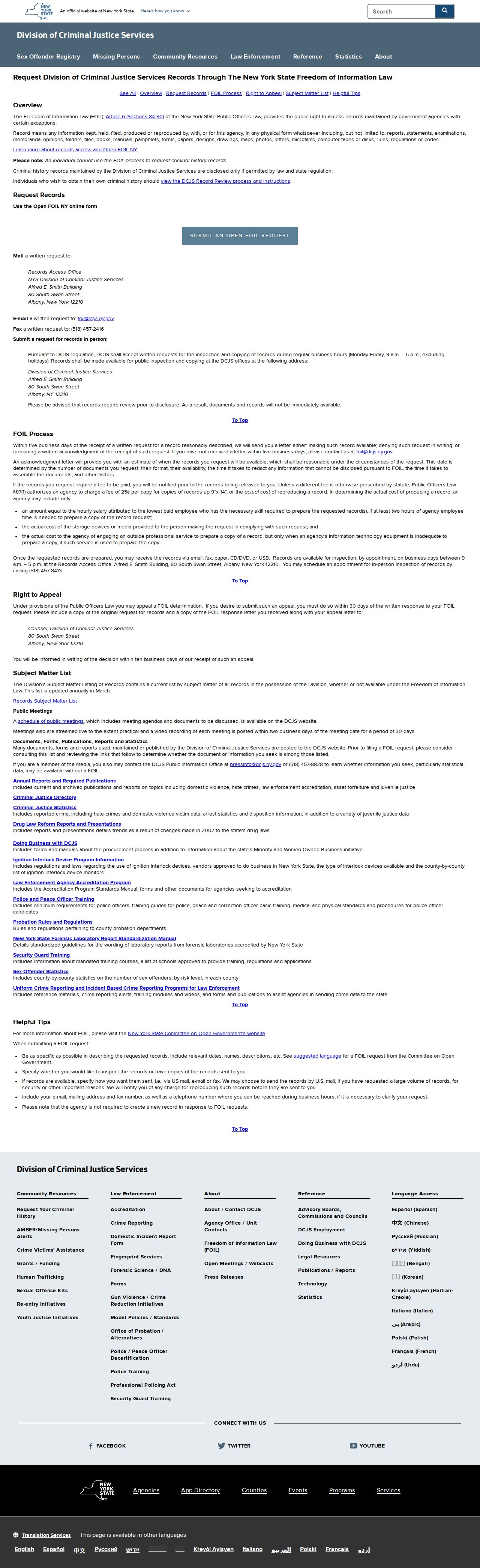
The public request channel should not be mistaken for Personal Record Review or OCA court access.
FOIL can still reach DCJS administrative material, contracts, policies, and other agency records unless an exemption applies. The agency acknowledges a request within the statutory framework and may charge permitted reproduction costs. Person-level criminal history follows controlled dissemination rules instead. A focused request should describe the agency record sought without asking FOIL staff to run a confidential rap-sheet search.
Fixing Errors in a NY DCJS Record
Begin with an unsuppressed review when the goal is to audit every maintained cycle. Compare each arrest, charge, disposition, sentence, and seal notation against certified source papers. An arrest error starts with the arresting agency. A wrong or absent disposition needs a certified Certificate of Disposition from the court. A missing seal needs the signed or certified sealing order.
- Order an unsuppressed NY DCJS Personal Record Review with fingerprints.
- Mark the disputed cycle and gather a certified court certificate or sealing order.
- Use the challenge directions enclosed with the response and send proof to Records Correspondence.
- Read the written DCJS decision and confirm the correction on a later review.
DCJS cannot invent a source disposition. The source court may need to correct or resend it. Seal verification uses the relevant CPL 160.50, 160.55, or 160.59 form and supporting order. DCJS estimates about two weeks for seal verification and offers no counter pickup.
A mistaken-identity claim requires fingerprint comparison, which is another reason a name-only court report cannot settle the issue. If the arresting agency contributed the wrong facts, ask that agency to send a written correction. For a court outcome, ordinary photocopies may not satisfy DCJS when certification or a raised seal is required. Keep copies of the challenge, proof, and written decision so a later review can be compared line by line.
NY DCJS and Clean Slate
New York's Clean Slate law took effect November 16, 2024, but statewide legacy sealing is still being implemented. OCA's planning documents say millions of eligible convictions must be processed by November 2027. During that work, an item may remain on Personal Record Review even though it is eventually eligible for automatic sealing.
This is a milestone, not proof that every old case is already sealed. A person should compare the NY DCJS response, current court status, and any sealing notice. If the court applied a seal but the rap sheet did not, use the DCJS verification and challenge route. Record sealing changes access; it does not rewrite the original event or eliminate the need to correct bad source data.