
New York Arrest History
New York arrest history begins with the agency that acts. A county sheriff, city or local police department, New York State Police troop, transit or campus department, or another authorized body creates its own incident and arrest records. The receiving jail creates a separate intake and custody record. No single statewide public roster combines all county bookings.
A fingerprintable arrest can enter the New York State Division of Criminal Justice Services system. The court later reports how the prosecution ended. That official DCJS record is fingerprint supported, but it is available to the person named or that person's attorney through Personal Record Review, not through a general public name search. A public search instead uses the creating agency, jail, WebCrims, and the source court.
Four New York Arrest Records
One New York arrest can create four records with different custodians and clocks. They can show different charges or dates without any one being false. The arrest report captures the officer's narrative and probable-cause basis. The booking file addresses intake and custody. The court docket reflects charges accepted or changed in court. The DCJS cycle links qualifying fingerprints to prosecution and disposition data.
| Record | Creator | Best use |
|---|---|---|
| Arrest or incident report | Arresting agency | Event narrative, initial charge, property, and evidence fields |
| Booking or custody record | County jail or NYC custody agency | Admission, booking number, release, and current local custody |
| Criminal court docket | Originating court | Filed charges, appearances, disposition, and sentence |
| Official rap sheet cycle | NY DCJS | A person's fingerprint-linked statewide arrest and prosecution history |
A searcher should select the record that answers the question. The police report cannot prove the outcome. A jail entry cannot show every later court change. The court file is not a statewide fingerprint history.
How New York Arrests Reach the Record
New York CPL 160.10 controls fingerprinting after qualifying arrests. The agency associates the fingerprint event with charge descriptors, a New York State Identification number, and transaction data, then submits it to DCJS. The jail separately records booking and custody. After arraignment and prosecution, the Office of Court Administration reports the disposition so DCJS can link the outcome to the arrest cycle.
Data flow: Arrest › Booking › Fingerprint Submission › NY DCJS Repository Entry
Not every citation or low-level event is fingerprintable. A name-only local event may not create a DCJS cycle. Reporting delays, spelling differences, or an unlinked disposition can also make systems disagree. “No disposition reported” means the state file lacks a linked outcome. It does not mean the case ended without conviction. Check the court file.
New York Arrest Data in Context
The New York Uniform Crime Reporting program receives monthly reports from police and sheriffs, reviews the data, and transmits qualifying information to the FBI.
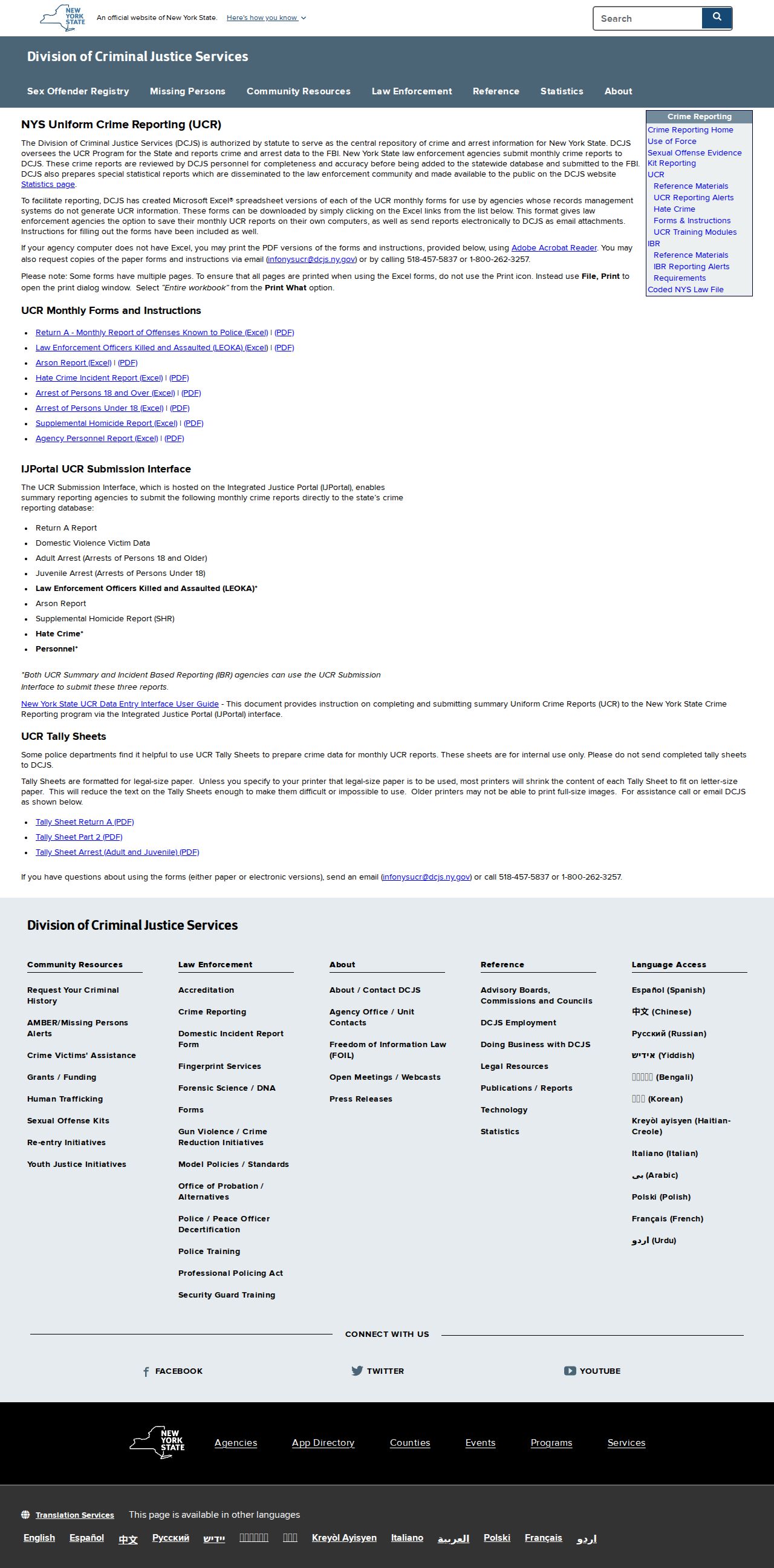
The program publishes aggregate crime and arrest statistics, not personal arrest records. Its units must not be mixed with court dispositions or unique-person counts.
DCJS processed 415,778 arrest fingerprint requests in 2024. The same year's felony processing report counted 153,647 felony arrest events, including 93,361 in New York City and 60,286 outside it. Those are events, not unique people or convictions. The report separately recorded 32,868 felony indictments or superior court informations, 20,536 adult or youthful-offender felony convictions, and 11,323 prison sentences. Later court events may stem from arrests in prior years.
The open Adult Arrest series counted 404,257 adult fingerprintable arrest events in 2025, classified by the most serious arrest charge. DCJS marks those data as preliminary and revisable. They cover fingerprintable arrests of adults, not every summons or violation. Use the county and agency dashboards for local comparisons rather than inferring a county result from a statewide total.
Looking Up Arrests in New York
A complete New York arrest lookup uses a local track for recent activity and an official self-review track for the statewide fingerprint history. There is no public DCJS name-search product. OCA CHRS is court derived, exact name and exact date of birth based, and not a fingerprint rap sheet. WebCrims is useful for active case status but has coverage gaps.
- Identify the arresting county and agency. Check its official press or blotter source if one exists, but expect short retention and incomplete coverage.
- Check the county jail or NYC custody system for present local custody. Use New York VINE as a participating-agency status and notification supplement.
- Search WebCrims for the court appearance, then verify charges and outcome with the court clerk.
- Request the incident or arrest report from the creating agency using a report number, event type, date, location, and precise record description.
- For a fingerprint-matched audit of one's own statewide record, order DCJS Personal Record Review through IdentoGO.
- Open the directory of all 62 New York counties to reach the sheriff, jail, county clerk, and local court channels that created the record.
When the arrest and prosecution occurred in different places, inspect both the arresting agency's county and the prosecuting court shown on the docket. A same-day booking can precede online court data.
Recent New York Arrest Without a Roster
Many New York counties do not offer a public live jail roster. Start with the jail's official telephone or record channel. New York VINE can provide status and notifications for participating custody agencies, but it is not a booking sheet, criminal history, or complete transfer tracker. WebCrims may not appear until the court enters a case and future appearance.
Ask the arresting agency for the existing report instead of asking it to explain why someone was arrested. A focused request names the incident number, date, time, location, people involved, and specific portions sought. New York State Police holds only records it created. Local police and sheriffs retain their own files.
Note: Different update cycles make a same-day mismatch between a New York jail, WebCrims, VINE, and the court clerk entirely possible.
Inside a New York Arrest Record
A New York arrest record describes an accusation and custody event. Public copies can redact victim, juvenile, medical, confidential-source, protected personal, and active-investigation information. Initial charges may differ from charges later filed by a prosecutor or sustained by a court. Read each field in that limited context.
| Name & Identifiers | Name used, aliases, and protected identity fields; a DCJS cycle can include NYSID and transaction data |
|---|---|
| Date, Time & Location | When and where the reported arrest occurred |
| Arresting Agency | The sheriff, police department, State Police, authority, or federal body that created the event |
| Charges at Arrest | Penal Law or other citations and offense class alleged at that stage |
| Report & Booking Numbers | Agency and jail identifiers used to request the local records |
| Custody & Release | Admission, arraignment, bail or release status, and custody dates where public |
| Linked Court | The arraignment court, docket, or warrant reference when reported |
A probable-cause narrative records the agency's account. It is not a judicial finding. The court disposition, not the arrest sheet, answers whether the charge resulted in conviction.
New York Arrest and Custody Layers
Local jail, state prison, and federal custody are separate. County jails and NYC custody hold people before trial, people serving local sentences, and people awaiting transfer. The New York State Department of Corrections and Community Supervision manages sentenced state-prison custody. The Federal Bureau of Prisons is a third system.
| Custody layer | Official starting point | What it omits |
|---|---|---|
| County or NYC jail | Local jail channel or participating VINE record | State prison, federal custody, and full case outcome |
| DOCCS prison | DOCCS Incarcerated Lookup | County bookings, police narrative, and full rap sheet |
| Federal custody | BOP Inmate Locator | New York local and state custody |
The official Federal Bureau of Prisons locator demonstrates the federal route that sits outside a New York arrest and DOCCS search.
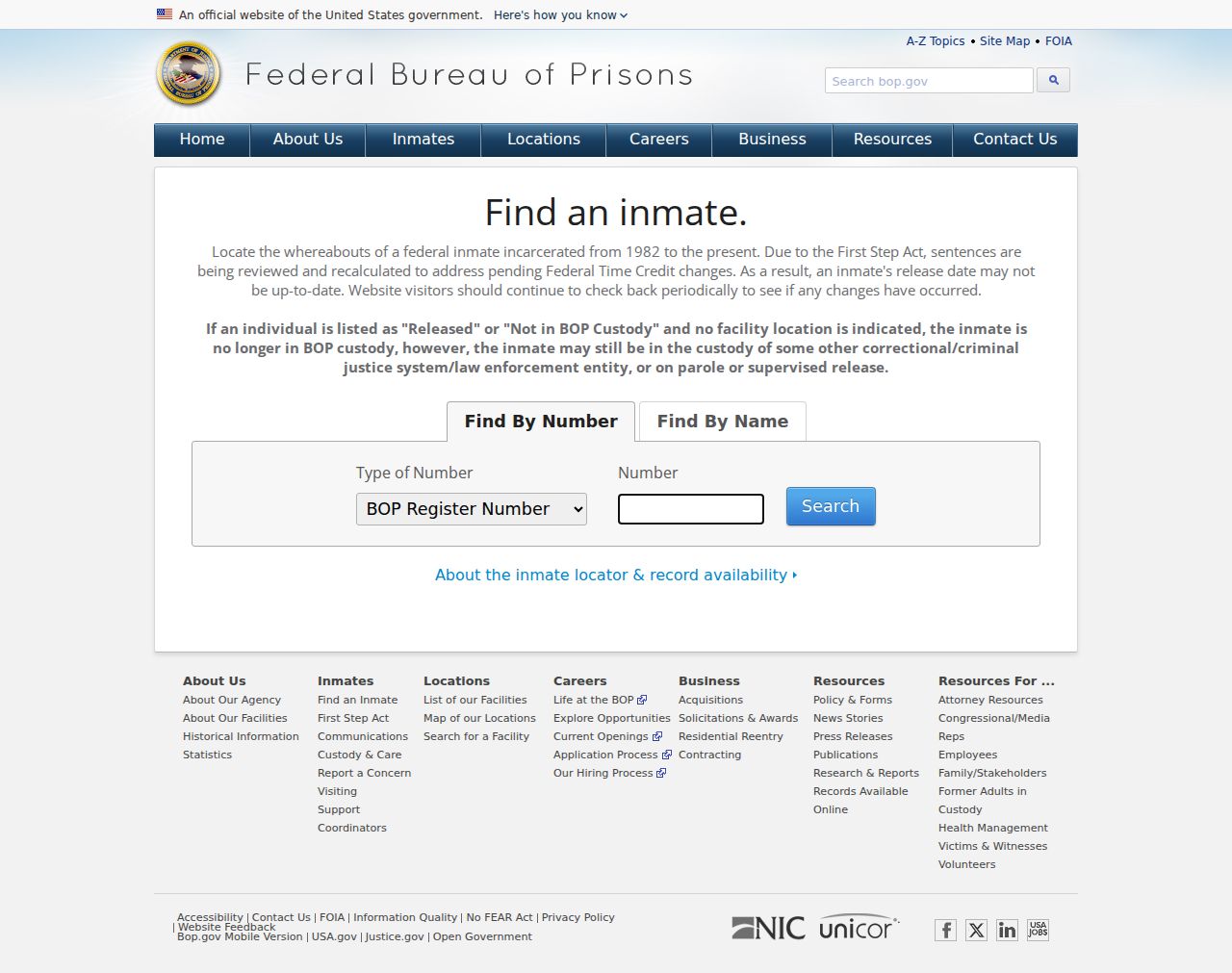
A BOP result does not supply the local New York booking sheet or state court disposition. Use the appropriate court docket and creating agency for those records.
New York Arrest Photos and Privacy
New York does not operate a universal statewide mugshot gallery. A 2019 FOIL amendment generally treats disclosure of arrest and booking photographs as an unwarranted invasion of privacy unless release serves a specific law-enforcement purpose and is otherwise lawful. DOCCS also does not publish mugshots in its public locator.
A county may release a booking record without releasing the image. Agency practice and the governing exemption control the response. Private mugshot galleries are not a valid substitute for an official New York record and should not be used. Booking photographs are not republished here.
Arrests vs Convictions in New York
An arrest is an accusation event. A conviction is a court judgment based on a guilty plea or verdict. New York systems preserve that distinction. Charges can be dismissed, reduced, amended, or resolved by acquittal. A favorable termination may trigger sealing under CPL 160.50. Eligible convictions follow narrower sealing rules, including application-based and Clean Slate routes.
| Arrest Record | Conviction Record | |
|---|---|---|
| Created by | Arresting agency and booking custodian | Court judgment, later reported to DCJS |
| What it proves | An arrest and allegation were recorded | Guilt was established by plea or verdict |
| Public access | Agency or jail channel, subject to FOIL exemptions and sealing | Public court channel when not sealed or otherwise restricted |
| Record sealing | Favorable-termination sealing may restrict the arrest cycle | Only eligible convictions qualify under the applicable statute |
Note: A New York arrest entry with no disposition is not proof of guilt; verify the outcome with the court that heard the case.
If a dismissed matter still appears, obtain the source court disposition, review one's own DCJS Personal Record Review, and use the DCJS challenge or seal-verification process when the two do not match.