
Criminal Court Cases in New York
New York criminal court cases can begin in a local court and move to a superior trial court. Outside New York City, Town and Village Justice Courts, City Courts, and the Nassau-Suffolk District Courts handle misdemeanors, violations, and felony preliminary proceedings. Indicted felonies generally move to County Court. Inside New York City, Criminal Court handles misdemeanors and felony preliminary matters, while Supreme Court Criminal Term tries indicted felonies. The word “Supreme” can confuse searchers because New York uses it for a trial court, not the state's highest court.
The court clerk keeps the judicial file. It can include the accusatory instrument, docket, orders, appearances, disposition, and sentence. Police narratives stay with the arresting agency, and the official fingerprint-supported rap sheet is maintained by the New York State Division of Criminal Justice Services. A New York court case file and a DCJS criminal history answer different questions. One shows the legal proceeding. The other compiles fingerprint-linked arrest and outcome data reported from across the state.
New York Criminal Court Map
Court level determines where a New York criminal case record lives and where an appeal goes. Local courts retain many misdemeanor files. County Court or Supreme Court may acquire a new felony file after indictment or a superior court information. Appellate review then creates another docket without removing the trial record. The correct route depends on both geography and charge level.
| Court | Typical criminal work | Record route |
|---|---|---|
| Town, Village, City, or District Court | Misdemeanors, violations, and felony preliminary matters | Clerk of the local court |
| NYC Criminal Court | City misdemeanors and felony preliminary matters | Criminal Court clerk |
| County Court | Felony trials outside New York City | County Court or County Clerk |
| Supreme Court Criminal Term | Felony trials in New York City | Supreme Court criminal-term clerk |
| Appellate courts | Review of trial-court rulings | Appellate docket plus the original trial file |
This structure explains why a search confined to one portal may miss part of a New York criminal case. Specialty parts such as drug treatment or mental-health court are programs within the Unified Court System, not separate statewide repositories.
Searching OCA WebCrims
OCA CHRS Direct Access offers an official view of the paid statewide court-history channel used alongside WebCrims. The captured portal shows why the two products must not be treated as interchangeable.
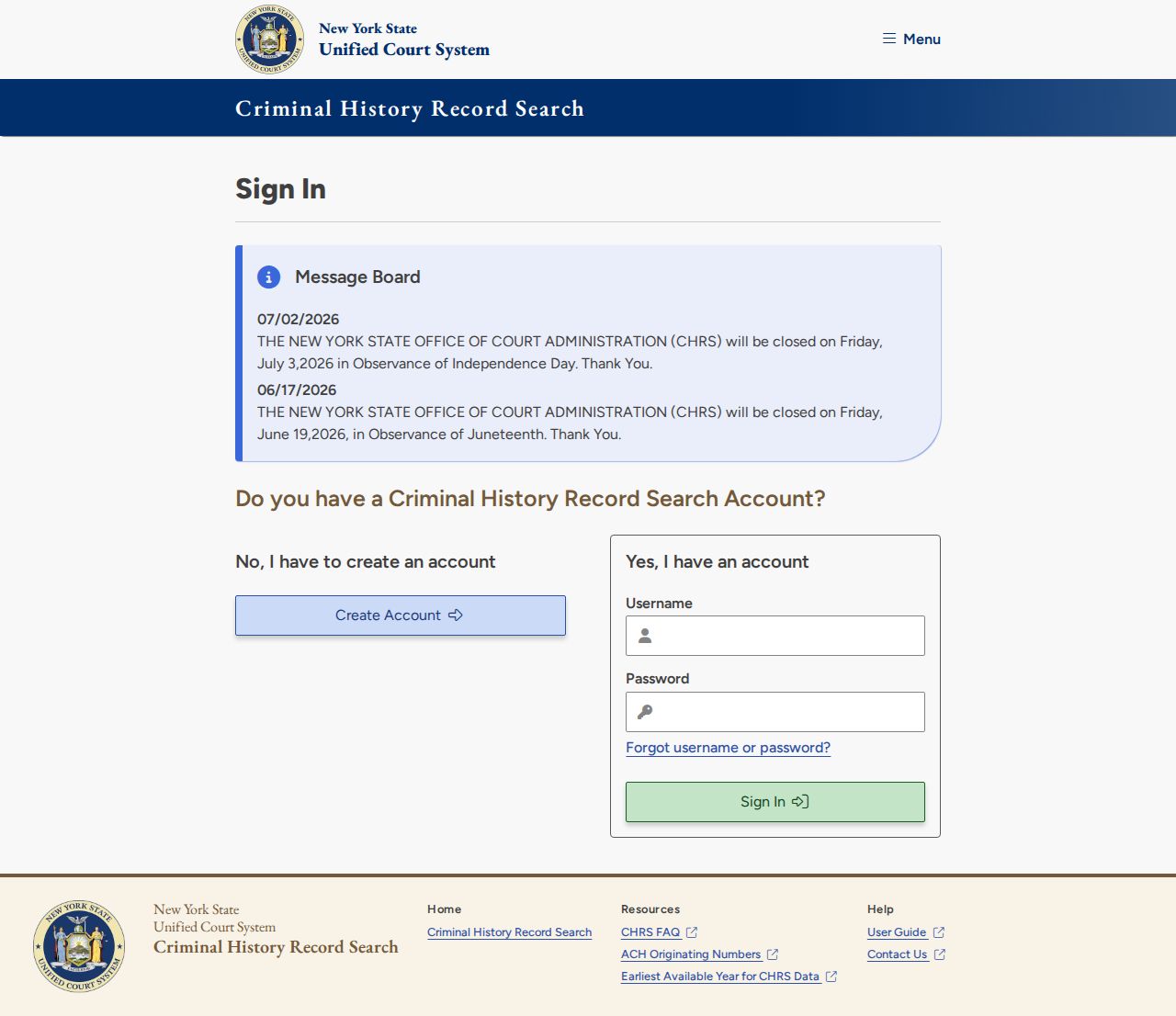
CHRS uses an exact name and exact date of birth, while WebCrims is the free tool for participating public cases, calendars, and current status. Follow the record to its source before relying on the result.
- Open WebCrims and choose the defendant or case-number route.
- Enter the court spelling of the name, or preserve the case identifier's leading zeros, hyphens, and any terminal letter.
- Use the court filter when available and review the case status, charges, and next appearance.
- Save the court, county, case number, and date checked. These details make a clerk request reproducible.
- Ask the originating clerk for filed papers or a Certificate of Disposition when the outcome must be verified.
| Field Label | Type | Required | Notes |
|---|---|---|---|
| Defendant / Case Number | Tabs | One route | Switches the search method |
| Last Name | Text | Name route | Try the spelling used by the court |
| First Name | Text | Name route | Narrows common names |
| Case Number | Text | Case route | Uses the docket, indictment, or summons identifier |
| County or Court | Filter | Optional | Narrows results where the portal provides it |
| Search / Clear | Buttons | No | Submits or resets the form |
New York Felony Case Numbers
One New York felony may have two case numbers. The matter can start under a local criminal-court docket for arraignment and preliminary proceedings. After indictment, it moves under a County Court or Supreme Court indictment number. A valid grand-jury waiver and superior court information can create the same two-stage trail. Those numbers may describe connected stages, not separate arrests.
Compare the defendant name, originating court, charges, arrest date, and transfer or indictment entries. An arrest charge may also be amended, reduced, dismissed, or replaced. The accusatory instrument shows what was filed at a given stage. The disposition shows what the court finally decided. Never substitute the first booking charge for the final New York court outcome.
Note: Record both numbers when requesting New York felony papers so the local and superior court clerks can trace the full proceeding.
Inside a New York Criminal Case File
A public New York criminal case file organizes the prosecution around court identifiers and dated events. WebCrims can show a useful index, but it does not provide the complete filed-document set. Protected victim details, Social Security numbers, sealed matters, and youthful-offender adjudications are withheld. The clerk applies the governing access and redaction rules to each requested item.
| Case Number & Court | Docket or indictment identifier, county, court, part, and status |
|---|---|
| Charging Documents | Complaint, information, indictment, or superior court information and cited laws |
| Docket Entries | Appearances, motions, orders, warrant activity, pleas, and other dated events |
| Hearing Dates | Past and scheduled appearances, court part, and calendar information where public |
| Disposition | Dismissal, acquittal, conviction, or another recorded result for each charge |
| Sentence & Judgment | Custody, probation, conditional discharge, fine, surcharge, or restitution when public |
Bail addresses release before judgment. It is not a fine and proves no guilt. Likewise, “disposed” means an outcome was entered, not that the outcome was a conviction. Read the specific charge result and date.
Reading New York Criminal Dockets
Short status labels can hide major differences in a New York criminal court record. A docket must be read by charge and date. “Pending” signals that no final outcome has been entered. “No disposition reported” may indicate a reporting gap. A plea is not the same entry as sentencing, and a bench warrant concerns nonappearance or noncompliance rather than guilt on the underlying accusation.
- Arraignment
- The first appearance where charges are stated and release or custody is addressed.
- Disposition
- The recorded outcome of a charge or case.
- Indictment
- A grand-jury accusation supporting a felony prosecution in superior court.
- ACD
- An adjournment in contemplation of dismissal that may end in dismissal and sealing if its conditions are met.
- Certificate of Disposition
- The source court's certified statement of the case outcome, obtained from that court rather than WebCrims.
Charge citations may change as the case develops. A public display can use Penal Law or Vehicle and Traffic Law sections. If CHRS reports “no description available,” the code is missing from its dictionary. The source court, not a guess, resolves the entry.
How a New York Criminal Case Moves
A New York criminal case creates records in stages. The arresting agency records the event. The court receives a charging paper and conducts arraignment. A felony may proceed to a grand jury, indictment, and superior-court arraignment. Discovery, motions, and hearings follow. The matter can end by dismissal, plea, or trial, then move to sentencing and possible appeal. A misdemeanor may remain in the local court throughout.
Case flow: Charges Filed › Arraignment › Pretrial › Plea or Trial › Disposition › Sentencing
Each transition can add a custodian or identifier. WebCrims focuses on participating public cases and often on active cases with future appearances. Finished cases, warrant cases with no future date, Town and Village matters, treatment-only cases, and protected records can be absent. A blank result is not a statewide clearance.
New York Sealing Changes Case Results
New York record sealing changes what a public search can return. CPL 160.50 generally seals qualifying favorable terminations. CPL 160.57 creates automatic Clean Slate sealing for eligible convictions after the statutory periods, subject to exclusions and implementation. CPL 160.59 provides a separate application route for limited eligible convictions. Sealing restricts access; it is not physical erasure.
The New York courts' sealing guidance shows the official boundaries and Clean Slate route.
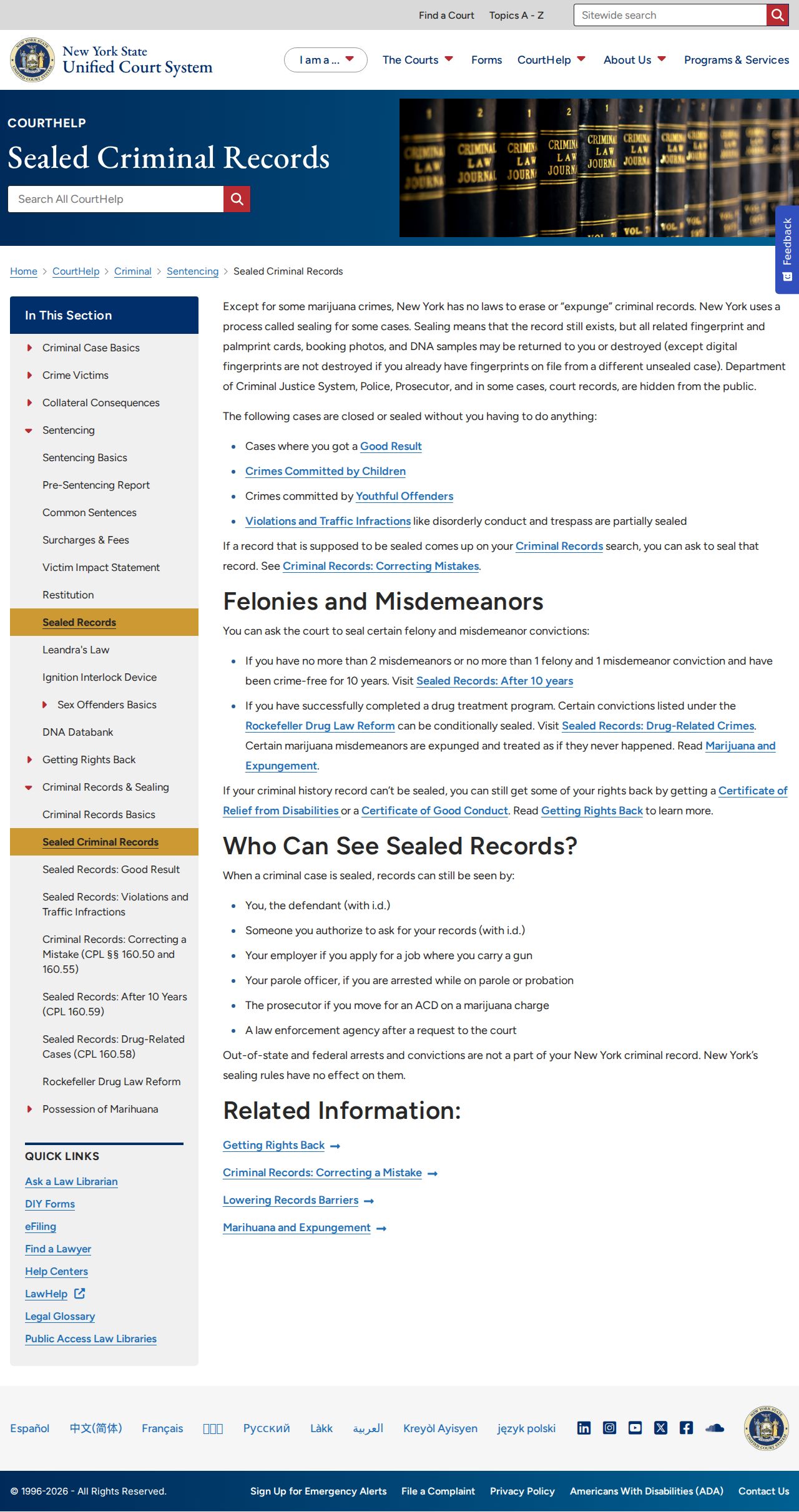
A sealed New York case can vanish from WebCrims and CHRS while remaining available to specifically authorized users. If a court order and a person's own DCJS record disagree, verify the seal with the source court and use the DCJS review or challenge process.
New York State and Federal Cases
New York state court tools do not cover federal prosecutions. Federal matters in the Northern, Southern, Eastern, and Western Districts use a separate docket system. The courthouse, case number, charges, and custody agency will signal which layer holds the record.
The official PACER federal court system provides account-based access to federal dockets.
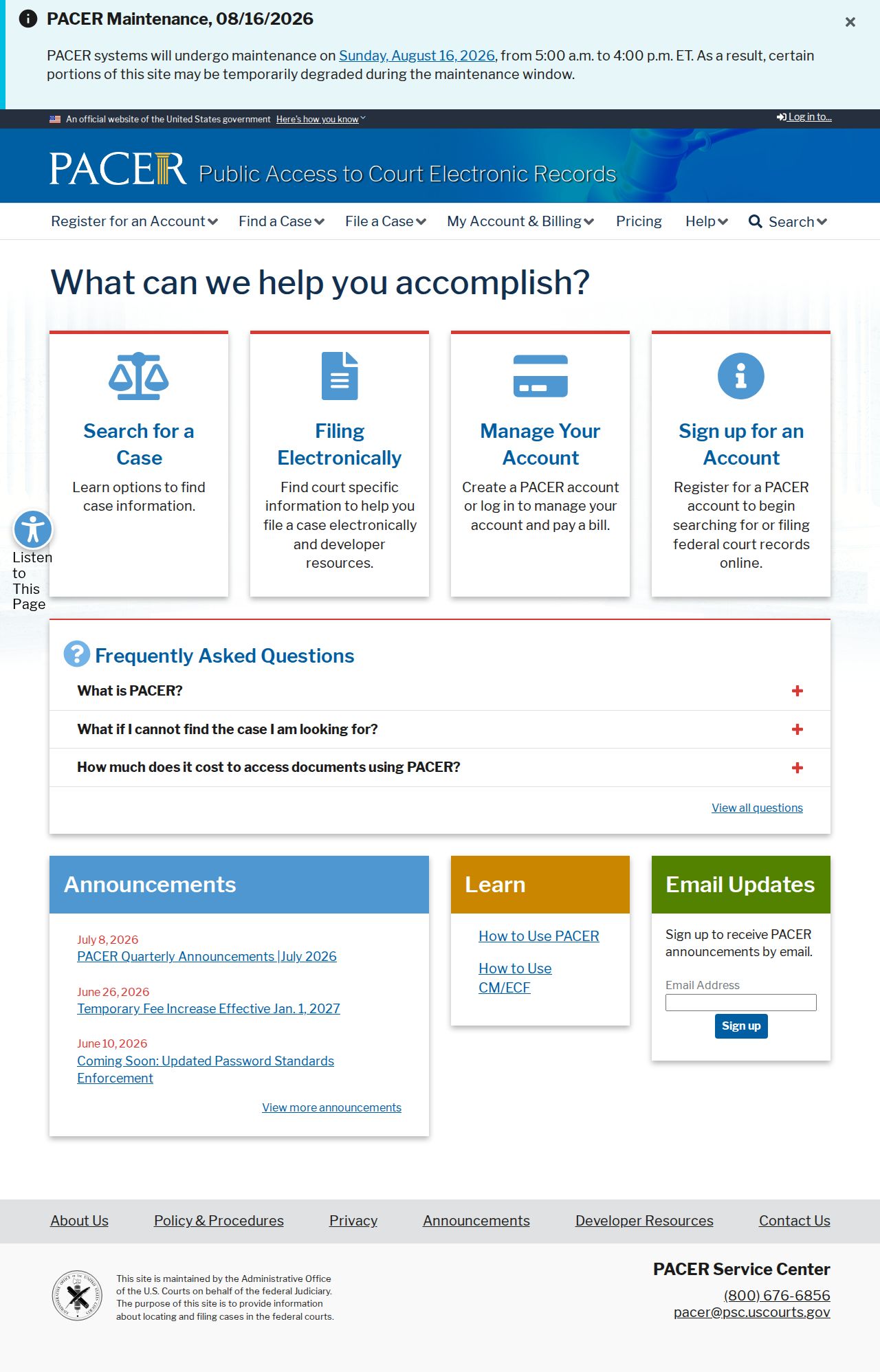
PACER does not replace a New York clerk for state charges, and WebCrims does not replace PACER for federal charges. When conduct produced matters in both systems, inspect both dockets and keep their identifiers separate.
Case Records at the County Level
The authoritative New York criminal case file stays with the court that heard the matter. Outside New York City, an indicted felony generally routes to County Court and often the County Clerk, while a misdemeanor may remain with a City, District, Town, or Village court clerk. In New York City, Criminal Court and Supreme Court maintain different stages. Older papers, minutes, exhibits, and certified copies often require a focused counter or mail request.
Use the New York county directory to identify the local criminal-record channels for the place of prosecution. Ask for an existing record by court, case number, party name, and approximate date. New York FOIL governs executive and local agency records, but judicial case files are requested from court clerks under court-access law. FOIL cannot turn a sealed court matter into a public record.